
Energy, Detectability, and the Foundations of SETI
Roughly half a century ago, Russian astrophysicist Nikolai Semenovich Kardashev introduced a foundational classification of extraterrestrial civilizations that fundamentally altered theoretical research into cosmic intelligence [s1]. Rather than speculating about alien social institutions, languages, or biology, Kardashev grounded his framework in measurable physical energy consumption. While critics have often viewed the classification as an oversimplification, spurring numerous proposals for alternative metrics and refinements, it endures as one of the primary conceptual tools for the rigorous theoretical investigation of SETI questions [s1].
The central strength of Kardashev’s scheme lies in its prioritization of astronomical detectability [s1]. By framing civilizations according to their energetic footprint, the classification transforms hypothetical beings from philosophical abstractions into potential observational targets. Modern conceptual movements, most notably Dysonian SETI, align closely with these observational developments and Kardashev’s core focus on detectability [s1]. By linking cosmic energy budgets directly to technological byproducts, the framework laid the groundwork for systematic astronomical surveys of the cosmos [s1].
The Three Tiers: Planetary, Stellar, and Galactic Energy Budgets
The original formulation by Kardashev established three discrete energetic tiers, each scaling upward by numerous orders of magnitude [s1]. A Type I civilization represents an entity capable of harnessing energetic resources equivalent to the total insolation and internal power available on its terrestrial home planet—roughly on the order of ten to the sixteenth watts. Such a civilization would manipulate planetary-scale weather systems, tap extensive geothermal and tidal reservoirs, and master total surface solar collection.
Moving up the energetic ladder, a Type II civilization commands the entirety of the power output emitted by its host star, approximating ten to the twenty-sixth watts. Achieving this scale implies the deployment of hypothetical megastructures, such as vast Dyson swarms or orbiting collector constellations that enclose stellar bodies.
At the apex of Kardashev’s classical schema sits the Type III civilization, an entity that has expanded its operational footprint across an entire galaxy. By harnessing the collective stellar emissions of billions of constituent stars, a Type III society would govern an energetic budget of approximately ten to the thirty-seventh watts. While these categories are idealizations rather than rigid real-world strata, they provide astronomers with clearly bounded orders of magnitude to evaluate what technological signatures might appear against the cosmic background [s1].
Thermodynamics and the Rise of Dysonian SETI
The lasting genius of Kardashev’s taxonomy lies in its synergy with the laws of thermodynamics, specifically the inevitable emission of waste heat [s1]. In physics, any civilization that captures, stores, and consumes energy to perform physical or computational work must eventually dissipate that energy into its surroundings in accordance with the second law of thermodynamics. Even if an ultra-advanced society shields its communications or abandons radio broadcasting altogether, it cannot evade the thermodynamic imperative to re-radiate degraded thermal energy.
This realization catalyzed the emergence of Dysonian SETI, an observational approach named after physicist Freeman Dyson that aligns directly with Kardashev's core emphasis on detectability [s1]. Rather than listening exclusively for deliberate narrowband radio greetings or optical laser pulses, Dysonian SETI searches for structural byproducts and environmental disruptions. When massive collector arrays absorb optical starlight to power industry or computational matrices, they warm up and re-emit the absorbed energy as mid-infrared and far-infrared radiation. A star or galaxy cloaked in technological infrastructure would therefore exhibit a distinctly anomalous spectral energy distribution: an unexpected deficit in visible light accompanied by an excess of diffuse infrared emissions.
Hunting Waste Heat: The G-hat Survey and Technosignature Searches
The practical efficacy of Kardashev's detectability framework has been rigorously tested through observational initiatives such as the G-hat infrared survey (2014–2015) [s1]. Researchers utilized space-based mid-infrared satellite catalogs, notably from NASA's Wide-field Infrared Survey Explorer (WISE), to systematically examine hundreds of thousands of galaxies across the observable universe [s1]. The survey's primary objective was to detect extreme Type III civilizations whose hypothetical megastructures would reprocess significant fractions of total galactic starlight into mid-infrared waste heat.
The G-hat survey established that full Type III civilizations are extraordinarily rare or nonexistent within the surveyed local universe, as no galaxies exhibited the unambiguous, massive thermal signatures that an omnipresent galactic civilization would inevitably produce. However, rather than undermining the validity of Kardashev's work, the G-hat findings demonstrated the remarkable utility of the scale: it allows astronomers to set empirical, quantifiable upper bounds on technological energy consumption across the cosmos [s1]. Theoretical models and real-world astronomical surveys now work in concert, transforming philosophical questions about alien abundance into systematic sky surveys [s1].
Epistemological Challenges and the Future of Cosmic Classification
Despite its enduring status as a cornerstone of theoretical SETI, Kardashev’s classification has generated extensive debate and refinement over the past half-century [s1]. Critics point out several conceptual challenges inherent to a purely energy-centric metric. Chief among these is whether advanced technological civilizations inevitably pursue endless exponential energy growth. In terrestrial computing, the historical trajectory often favors miniaturization, energy efficiency, and algorithmic optimization over sheer brute-force power consumption. A civilization could theoretically stabilize at modest planetary energy budgets while dramatically increasing its computational sophistication through reversible or quantum computing architectures.
Furthermore, observational astronomers face the daunting challenge of distinguishing hypothetical artificial waste heat from natural astrophysical environments. Obscuring dust clouds, protoplanetary disks, and starburst regions can naturally produce massive infrared excesses that closely mimic the predicted signatures of Dyson swarms.
Nevertheless, Kardashev's classification endures because its underlying logic remains scientifically robust [s1]. By anchoring the detectability of civilizations to the unyielding constraints of energy conversion and thermal re-radiation, Kardashev provided SETI with an objective physical roadmap [s1]. As next-generation orbital observatories probe deeper into the infrared spectrum, Kardashev’s fifty-year-old framework continues to guide our search for technosignatures among the stars [s1].
Sources & further reading
[s1] [1601.05112] Kardashev's Classification at 50+: A Fine Vehicle with Room for Improvement ↗arxiv.org
Updated 20/10/2026. Report a correction.Image credits
Related source image: Miitary Secret by Robert David Graham page 306
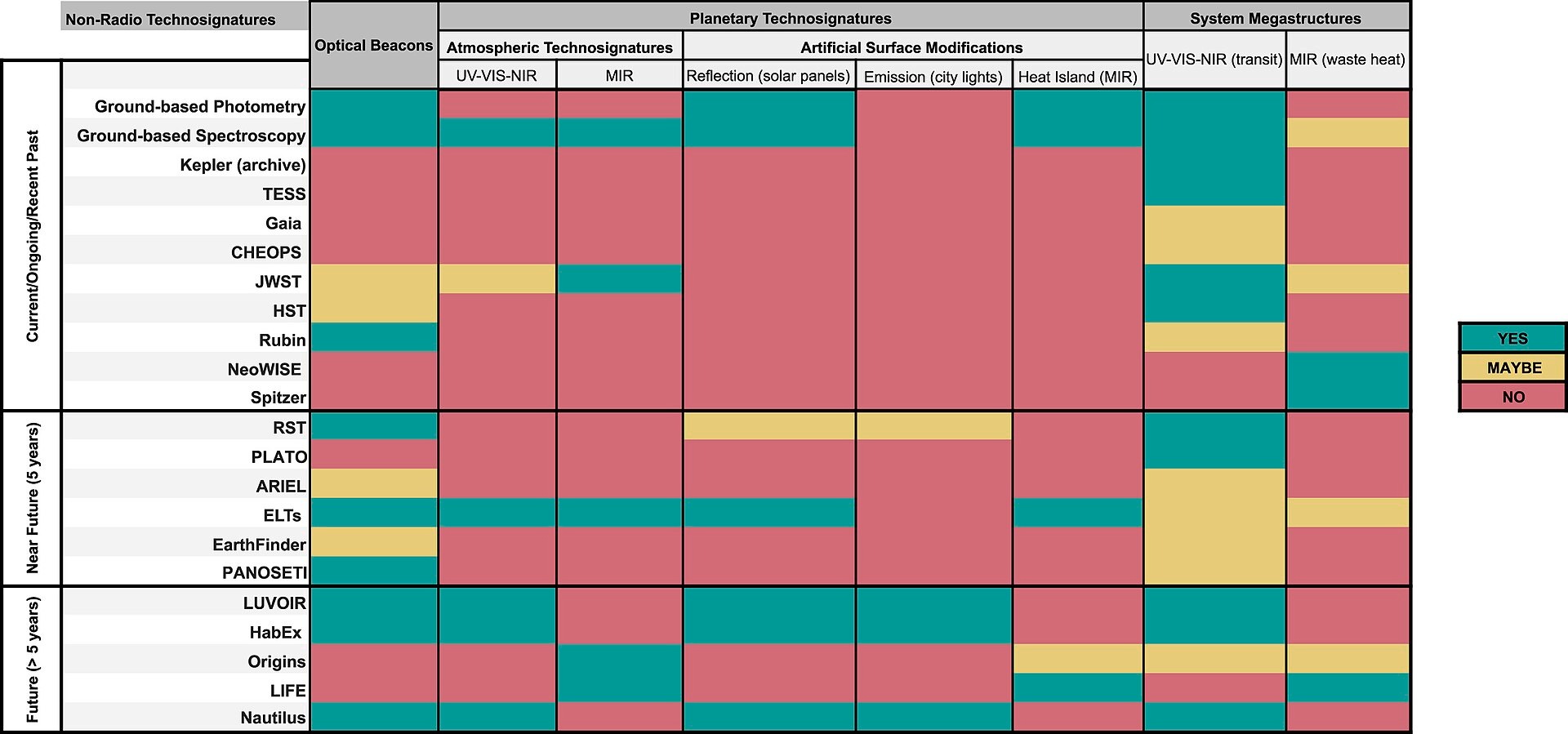
Source image · Capabilities for detecting technosignatures with recent, ongoing, and future missions and facilities · Authors of the study: Jacob Haqq-Misraa, Edward W. Schwieterman, Hector Socas-Navarro, Ravi Kopparapu, Daniel Angerhausen, Thomas G. Beatty, Svetlana Berdyugina, Ryan Felton, Siddhant Sharmaa, Gabriel G. De la Torre, Dániel Apai, TechnoClimes 2020 workshop participants · https://www.sciencedirect.com/science/article/pii/S0094576522002594 · CC BY 4.0 · · Cropped/resized for COSMORA; social versions add text · CC BY 4.0 license ↗ · Original image and rights details ↗
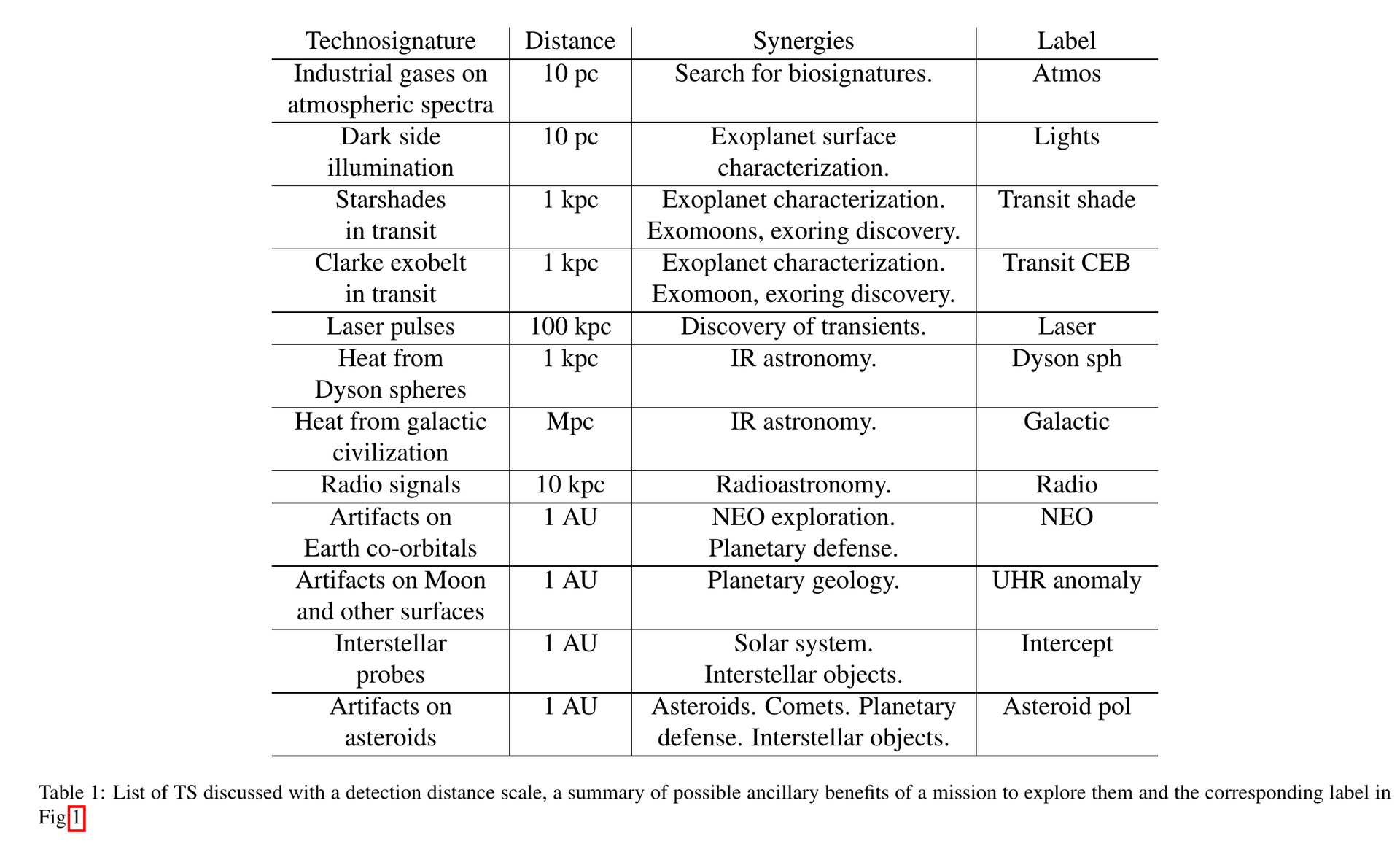
Source image · Table of technosignatures · Authors of the study: Hector Socas-Navarro, Jacob Haqq-Misra, Jason T. Wright, Ravi Kopparapu, James Benford, Ross Davis, TechnoClimes 2020 workshop participants · https://arxiv.org/abs/2103.01536 · CC BY 4.0 · · Cropped/resized for COSMORA; social versions add text · CC BY 4.0 license ↗ · Original image and rights details ↗
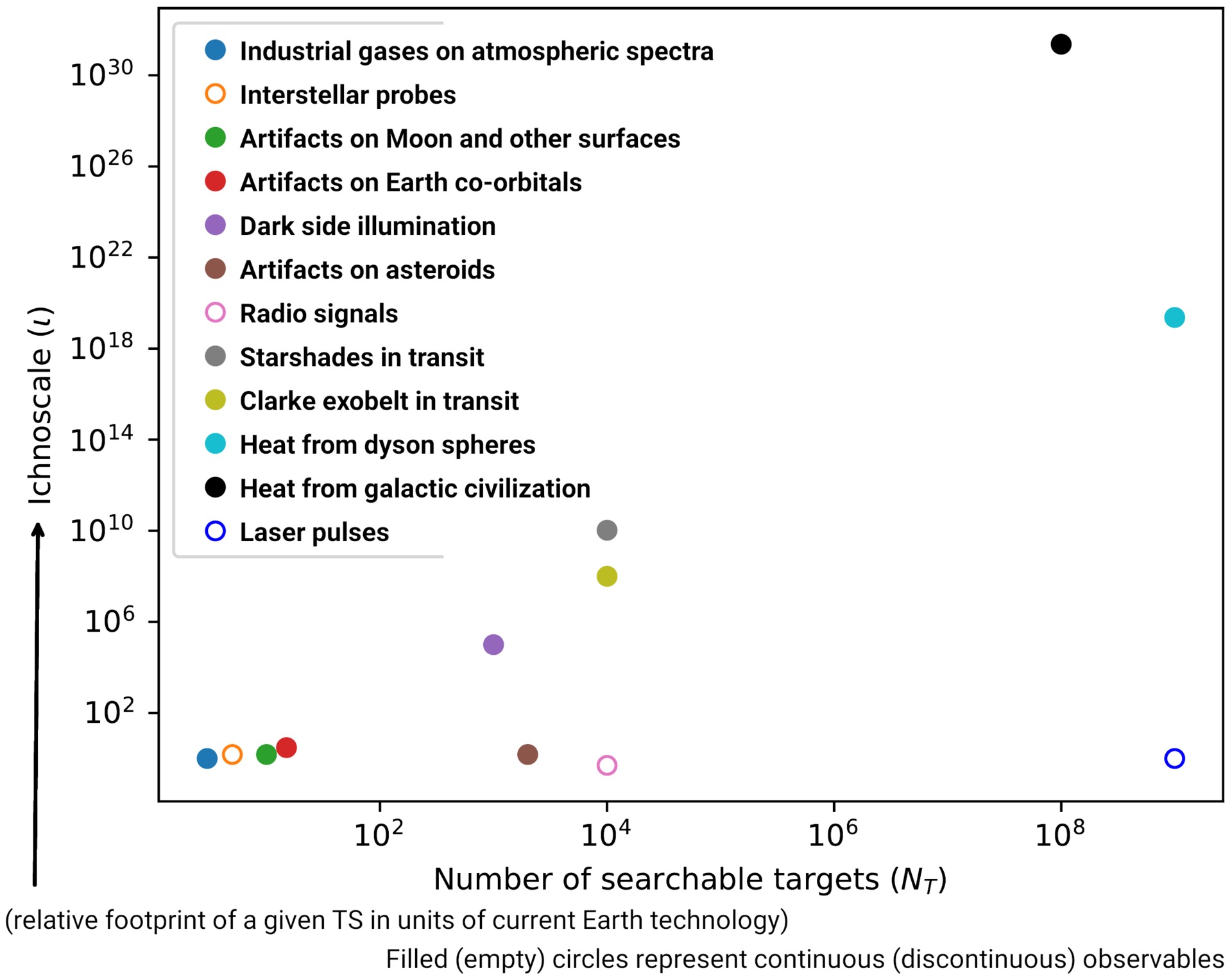
Source image · Technosignatures chart (labelled) · Authors of the study: Hector Socas-Navarro, Jacob Haqq-Misra, Jason T. Wright, Ravi Kopparapu, James Benford, Ross Davis, TechnoClimes 2020 workshop participants · https://arxiv.org/abs/2103.01536 · CC BY 4.0 · · Cropped/resized for COSMORA; social versions add text · CC BY 4.0 license ↗ · Original image and rights details ↗
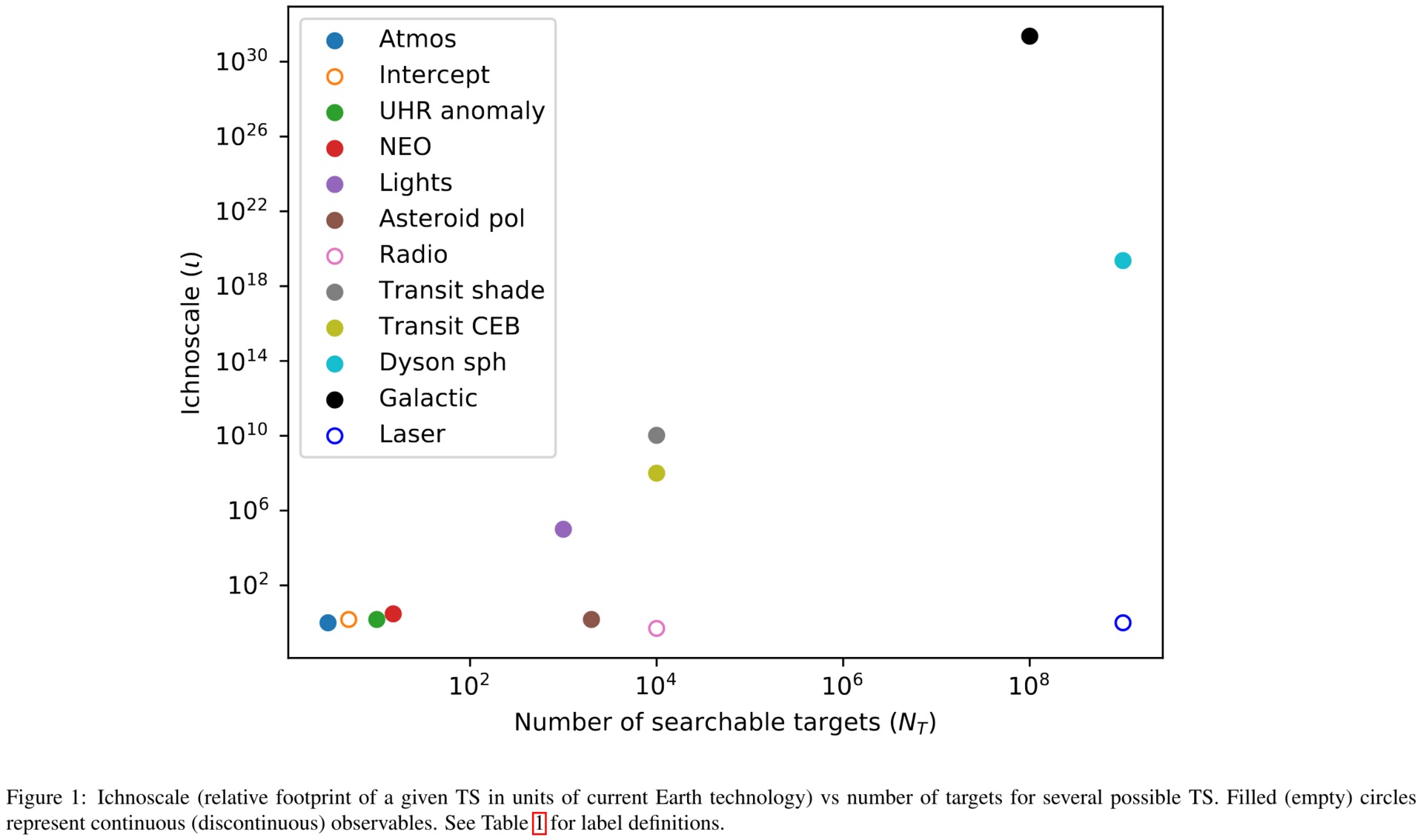
Source image · Technosignatures chart · Authors of the study: Hector Socas-Navarro, Jacob Haqq-Misra, Jason T. Wright, Ravi Kopparapu, James Benford, Ross Davis, TechnoClimes 2020 workshop participants · https://arxiv.org/abs/2103.01536 · CC BY 4.0 · · Cropped/resized for COSMORA; social versions add text · CC BY 4.0 license ↗ · Original image and rights details ↗
Source image · Miitary Secret by Robert David Graham page 306 · Thebobweb · CC0 · Original image and rights details ↗