LET CURIOSITY LEAD

Find your next rabbit hole.

1 story for “Red Dwarfs”

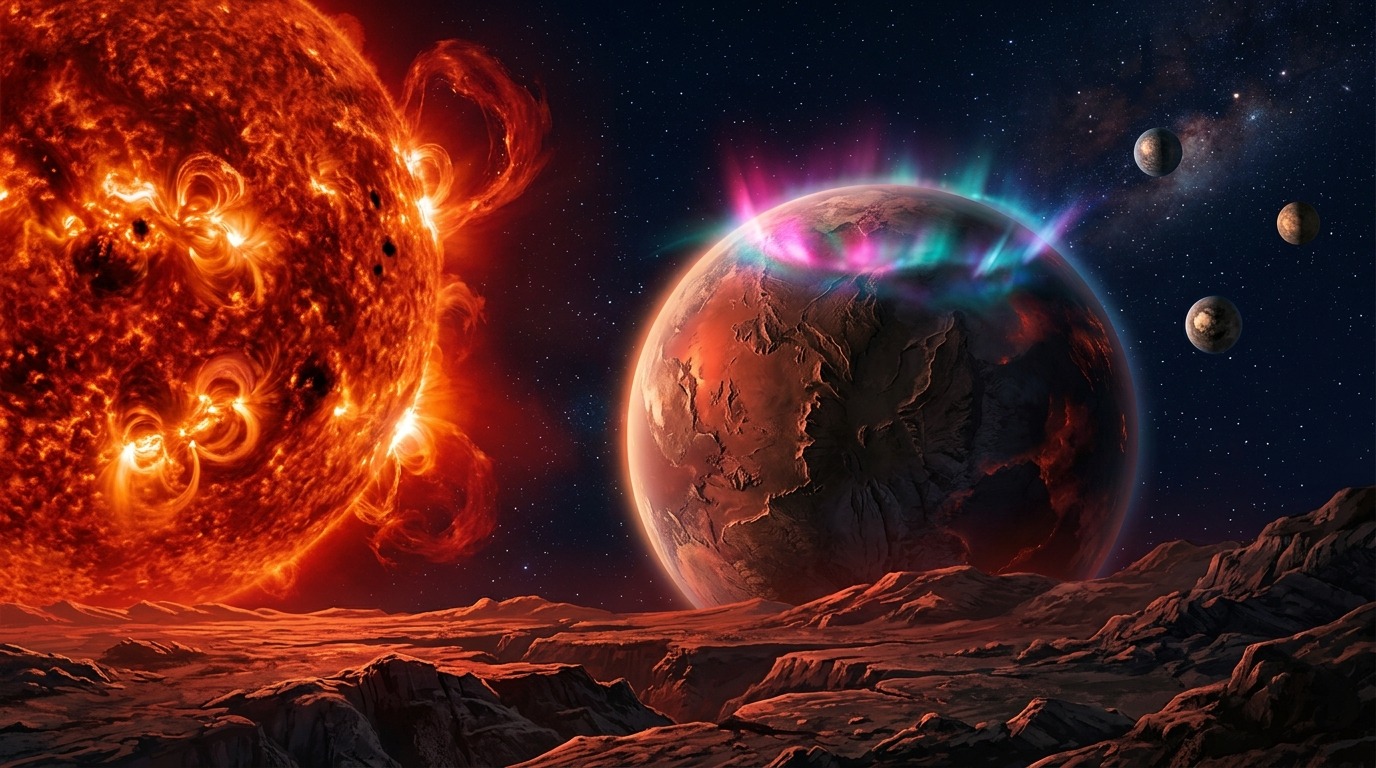
A cinematic, scientifically grounded digital illustration depicting an Earth-sized rocky exoplanet orbiting within the close-in habitable zone of a turbulent red dwarf star. The star looms large on the left, rendered in rich crimson and deep orange tones, with brilliant luminous solar flares and twisting prominence loops erupting across its surface. Ionizing ultraviolet and X-ray radiation cascades across interplanetary space, interacting with the planet's upper horizon in vivid magenta and teal shockwaves. The planet's foreground reveals a rugged, barren terrain of basaltic plateaus and deep canyons under stark, atmospheric-less shadows, illuminated by the intense, low-angled amber-red light of the host star. In the deep space background, contrasting cold navy and indigo starfields showcase distant sister planets in tight formation, evoking the compact architecture of systems like TRAPPIST-1.

Beyond the Goldilocks Zone: Why Orbital Position Alone Cannot Guarantee Life

While the circumstellar habitable zone identifies where orbital temperatures permit liquid water, planetary habitability depends heavily on stellar environment and atmospheric preservation. Most detected Earth-sized exoplanets orbit red dwarfs, where intense flaring, extreme ultraviolet radiation, and atmospheric loss present formidable barriers to life.