LET CURIOSITY LEAD

Find your next rabbit hole.

2 stories for “neutron stars”

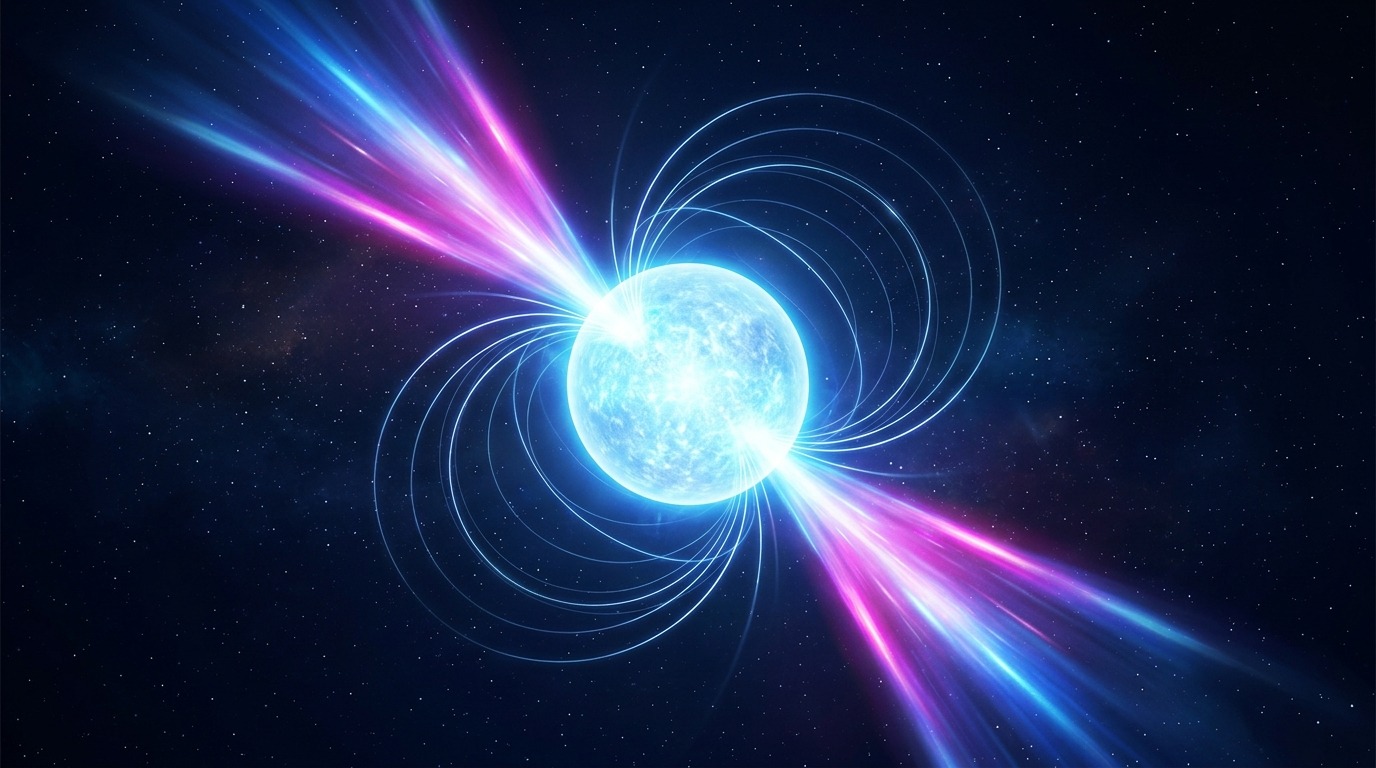
Artistic impression of a rapidly rotating pulsar in deep space. The focal subject is a glowing, compact neutron star sphere spanning only kilometers across, radiating intense blue-white surface thermal emission. Vivid, luminous conical beams of high-energy radiation sweep outward from its magnetic poles into the surrounding interstellar medium, casting brilliant magenta and electric blue highlights. Fine magnetic field lines loop around the equator in crisp, luminous arcs, with separated midtones keeping the structural geometry sharp and legible against a deep navy starfield. Clean, intentional directional lighting accentuates the spherical curvature and energetic polar outflows, avoiding muddy or flat textures. Designed in landscape 16:9 format for web display, clearly labeled as an artistic impression.

Cosmic Beacons: Why Dead Stars Flash Like Cosmic Lighthouses

Pulsars are hyper-dense neutron stars born from supernova core collapses. Spinning up to hundreds of times per second and boasting magnetic fields trillions of times stronger than Earth's, these stellar remnants funnel charged particles into radiant beams that sweep across space like cosmic lighthouse beacons.
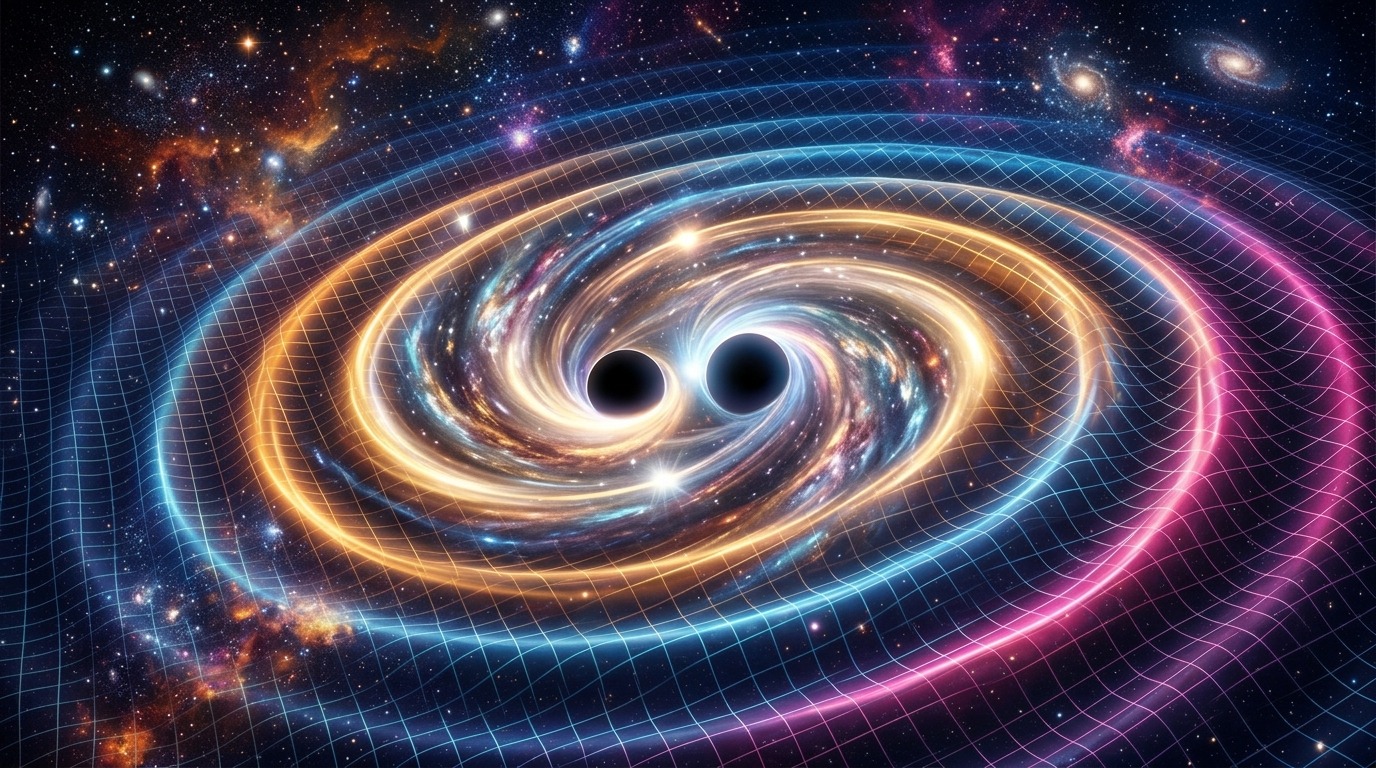
Artistic impression of two coalescing stellar-mass black holes distorting spacetime against a dynamic celestial field. The composition features high-contrast luminous amber and cerulean gravitational ripples radiating across an undulating spatial coordinate grid, framed by sharp lens flare highlights and clean separated midtones. No embedded text or false-color data overlays.

Measuring Spacetime: How Science Captures Cosmic Ripples

Gravitational waves are ripples in the fabric of spacetime produced by accelerating massive bodies like colliding black holes and neutron stars. This article explores how ground interferometers such as LIGO, pulsar timing arrays, and future space missions like LISA measure these minuscule cosmic distortions.