The Cosmic Lighthouses Born of Stellar Death
When a massive star between eight and twenty times the mass of our Sun exhausts its nuclear fuel, its life ends in a colossal supernova explosion [s1] [s5]. While outer layers are hurled across space, the stellar core undergoes violent gravitational collapse [s1] [s3]. Protons and electrons are crushed together under immense gravitational force, transforming into subatomic neutrons [s1] [s3]. If the collapsing core possesses a mass between 1.2 and 3 times that of the Sun, subatomic forces between neutrons prevent gravity from collapsing the remnant further into a black hole [s1] [s3]. The result is a neutron star—a compact stellar corpse holding more mass than the Sun compressed into a sphere merely 10 to 20 kilometers across, or less than 17 miles in diameter [s1] [s2] [s3] [s4].
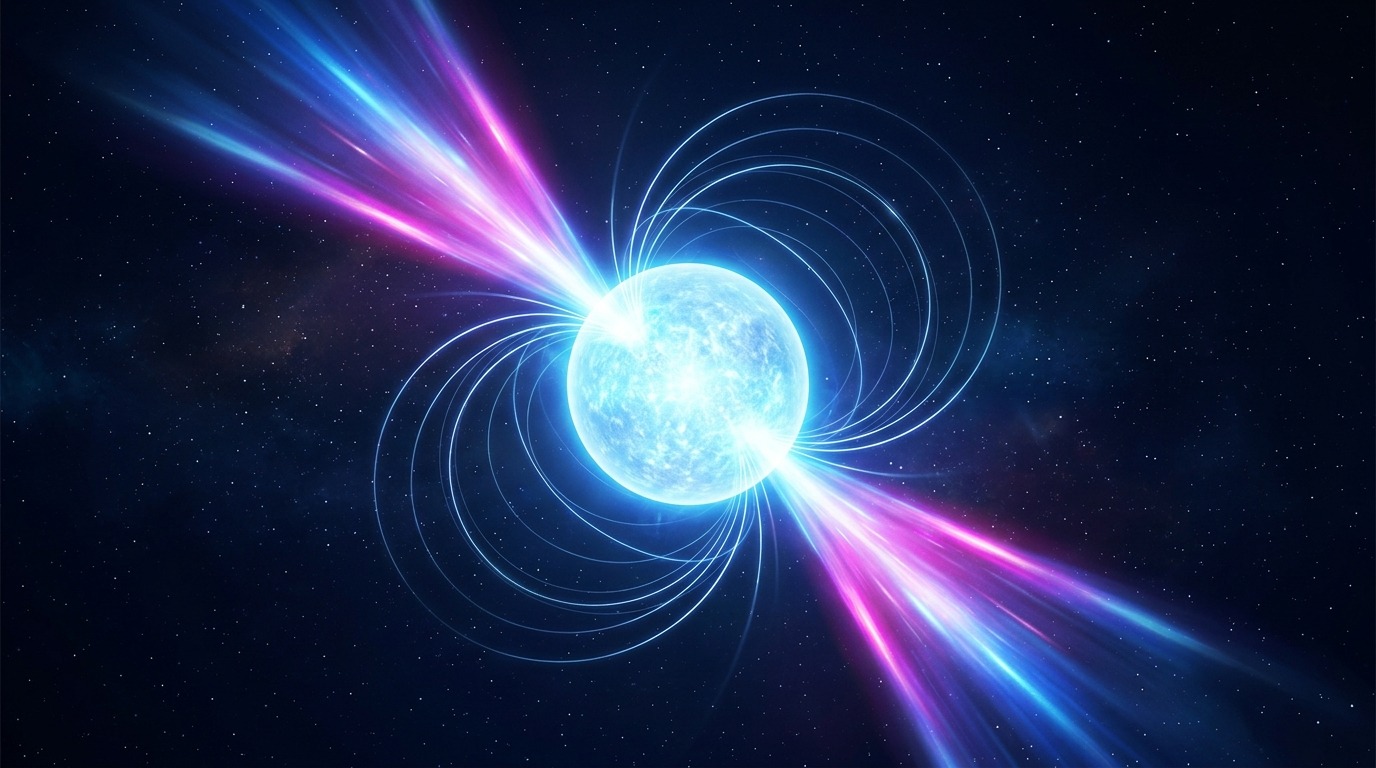
The density of this remnant defies ordinary earthly intuition. Squeezing several solar masses into a city-sized sphere means that a single thimble or teaspoon of neutron star material would weigh millions of tons on Earth, with a sugar-cube-sized portion equaling the collective weight of all human beings on the planet [s1] [s2] [s3] [s4]. Millions of these extreme stellar corpses populate our Milky Way galaxy [s2]. Many of them announce their presence across the cosmos as pulsars—fast-spinning neutron stars that act as cosmic lighthouses, sweeping concentrated beams of radiation through space [s1] [s2] [s3] [s4].
The Engine of Spin and Magnetic Acceleration
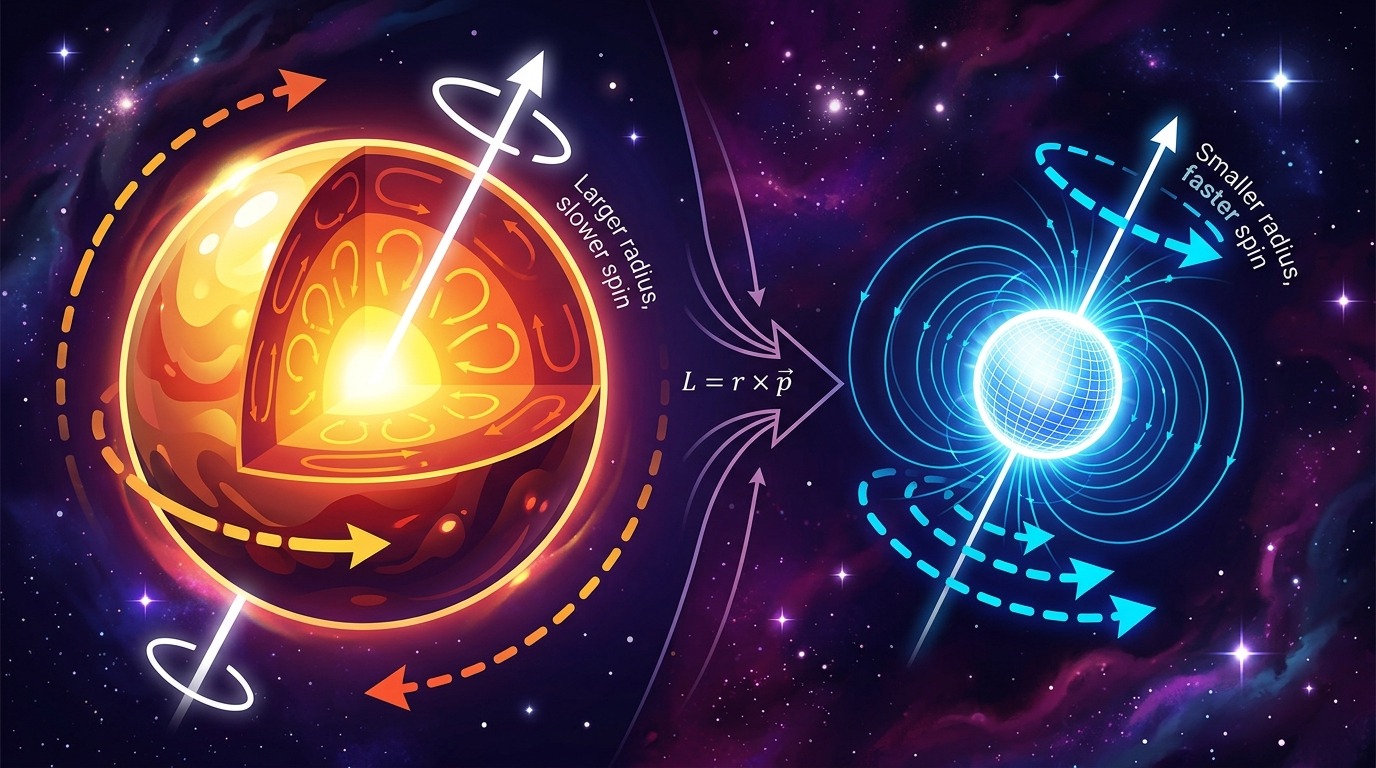
The signature characteristic of a pulsar is its astonishing rotation rate. As the progenitor star's vast core collapses into a tiny ball only kilometers wide, it spins up dramatically due to the conservation of angular momentum [s1]. This is the exact physical principle demonstrated when figure skaters draw their outstretched arms inward to accelerate their spin [s1]. Pulsars rotate rapidly, with some completing hundreds of revolutions per second [s1] [s2]. The slowest known pulsar requires almost 6.7 hours for a single turn, while the fastest known whirls at an extraordinary 716 rotations per second [s1] [s4].
In tandem with their rapid rotation, pulsars generate magnetic fields trillions of times stronger than Earth's magnetic field [s1]. While the precise physical mechanisms behind these immense fields remain under active investigation, astronomers hypothesize that the high magnetism of the progenitor star is retained and heavily magnified through the geometric compression of magnetic field lines during core collapse [s1]. These rotating magnetic fields act as potent particle accelerators, channeling charged particles along magnetic field lines until they reach speeds approaching the speed of light [s1]. Directional radiation beams—spanning radio waves, visible light, X-rays, and gamma rays—are launched into space from the pulsar's magnetic poles [s1] [s2]. Because these magnetic poles do not necessarily align with the star's rotational axis, the beams sweep through space in circles [s1]. When a sweeping beam periodically crosses Earth's line of sight, telescopes register a rhythmic pulse of emission [s1] [s4].
The Evolutionary Paradox and Spider Systems
Pulsars were first identified in 1967 by astrophysicist Jocelyn Bell Burnell while analyzing periodic radio signals from the Vulpecula constellation at the University of Cambridge's Radio Astronomy Observatory [s1]. The signals were so extraordinarily precise and consistent that Bell Burnell jokingly dubbed them "LGM" for "Little Green Men" [s1]. Shortly thereafter, theorists Franco Pacini and Thomas Gold identified these beacons as spinning neutron stars [s1]. Isolated pulsars gradually lose rotational energy over epochs, their spinning slowed by the drag of their radiation and magnetic fields [s1] [s4]. For example, the Crab Nebula pulsar, born approximately 970 years ago, rotates nearly 30 times per second, while the older Vela pulsar, formed roughly 11,000 years ago, spins about one-third as fast [s4]. Over deep time, isolated pulsars slow down so substantially that their electric currents cease, extinguishing their radiant beams permanently [s1].
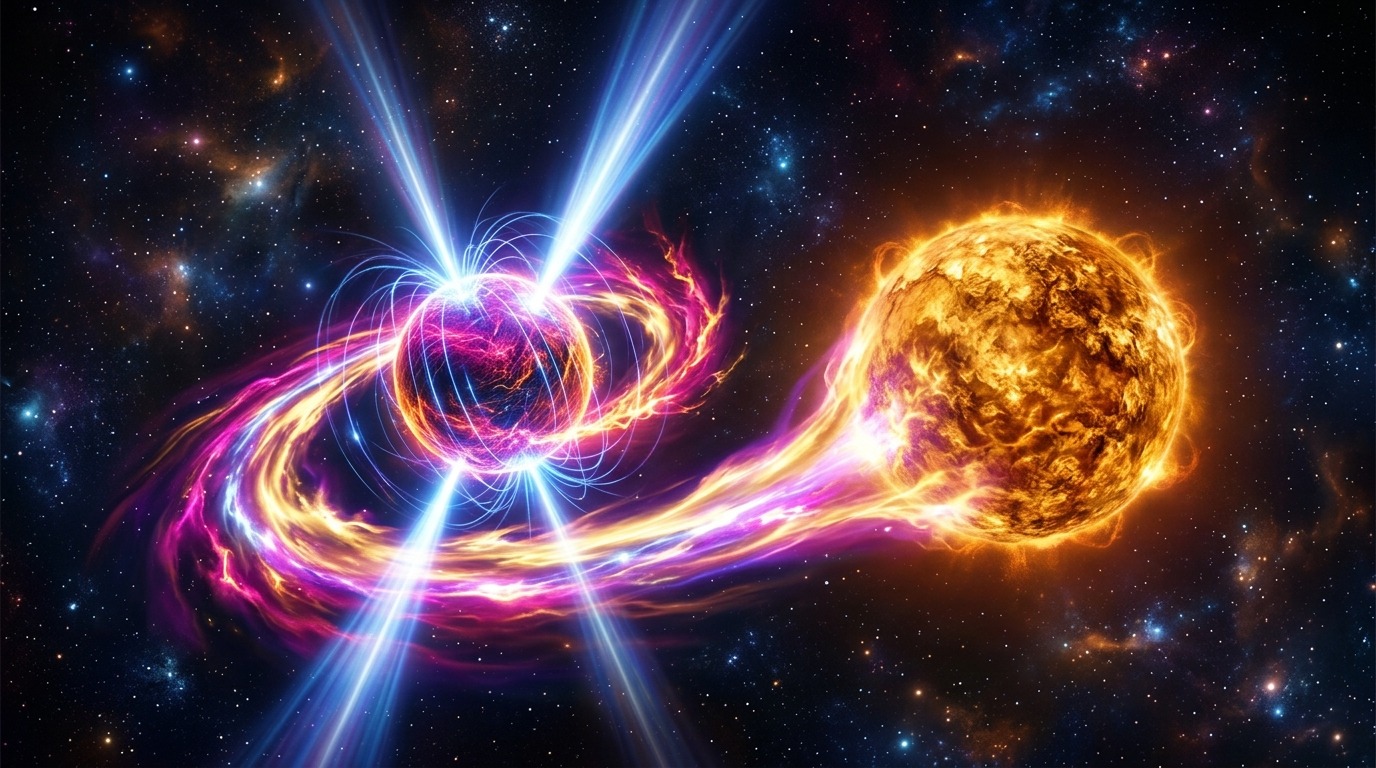
Astronomers encountered an intriguing puzzle: millisecond pulsars (MSPs) that are hundreds of millions of years old whirl hundreds of times per second, far faster than young remnants [s4]. For instance, J1824-2452A spins 328 times a second despite an estimated age of 30 million years [s4]. Binary systems explain this evolutionary paradox [s4]. If an older pulsar has a stellar companion, its intense gravity can pull a stream of accreted matter from the partner, transferring angular momentum and spinning the dead star back up to millisecond periods [s4]. These rejuvenated objects often form "spider" systems, classified as redbacks or black widows depending on whether the companion is heavier or lighter than about 5 percent of the Sun's mass [s4]. As the pulsar spins up, intense high-energy outflows heat and steadily evaporate the companion star [s4]. Some, like the black widow J1555-2908, show anomalous spin variations that may hint at an ensnared planet-sized third body [s4].
Multi-Wavelength Observatories and Space Navigation
The evolutionary dance between binary companions is illustrated vividly by transitional pulsars such as J1023+0038 [s4]. In this system, when an erratic gas stream from the companion surges, it forms a bright accretion disk around the neutron star that can endure for years [s4]. This swirling disk blazes in optical light, X-rays, and gamma-ray jets, while obscuring the regular pulsed radio signals [s4]. When the disk eventually dissipates, the high-energy emission recedes and the clean radio pulses re-emerge [s4]. Meanwhile, solitary pulsars can exhibit sudden shifts; the isolated pulsar J2021+4026 underwent a mode change in 2011, dimming in gamma rays over a week before recovering years later, potentially caused by structural crustal cracking altering its magnetic geometry [s4].
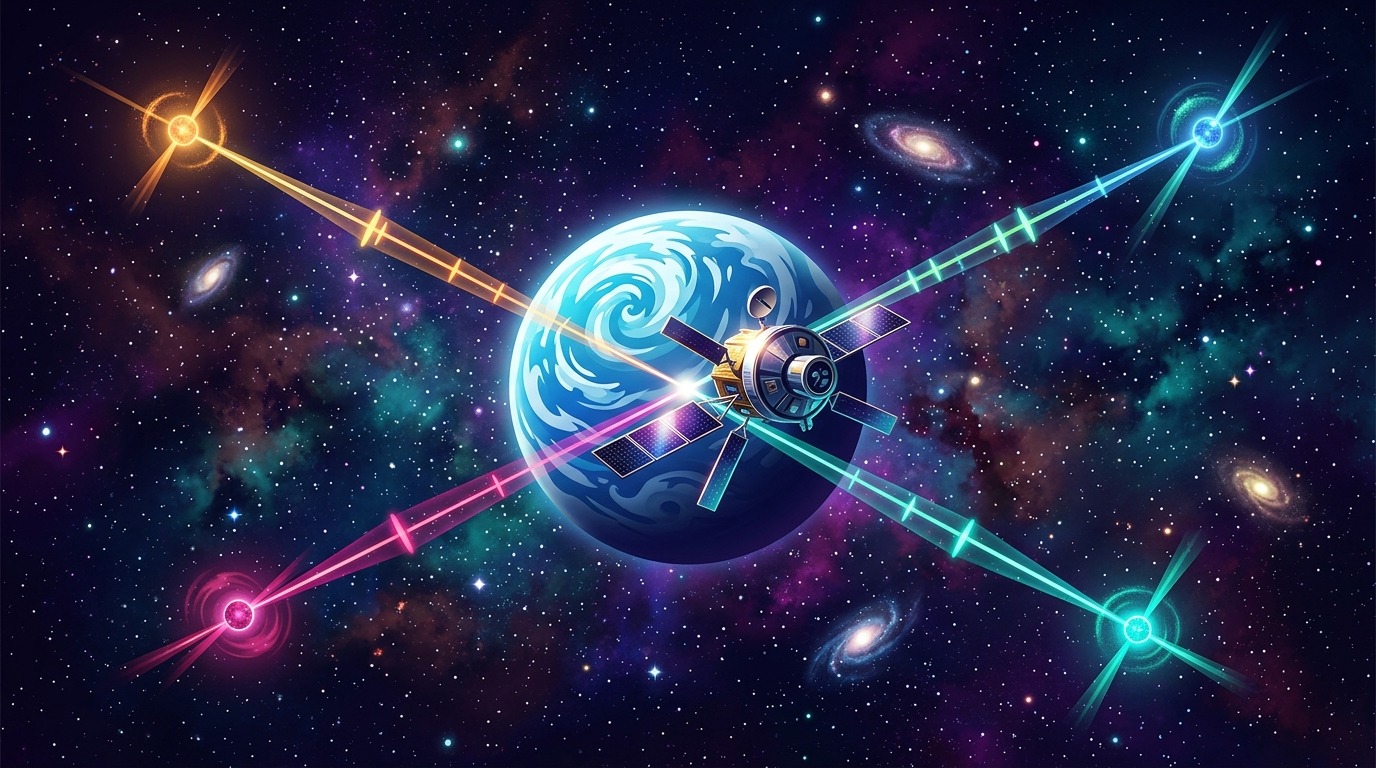
Modern space observatories have completely reshaped our perspective on pulsar energetics. NASA's Fermi Gamma-ray Space Telescope expanded the catalog of gamma-ray pulsars from 11 known prior to its 2008 launch to 294 confirmed objects, with 34 candidates awaiting confirmation [s4]. While only about 10 percent of the roughly 3,400 known pulsars emit gamma rays, millisecond pulsars radiate predominantly at these high energies [s4]. In visible light, the Hubble Space Telescope has imaged expanding rings of pulsar wind material surging outward into the Crab Nebula at half the speed of light [s1]. Furthermore, the extreme rotational stability of pulsars allows them to serve as practical deep-space clocks [s1] [s4]. The SEXTANT experiment aboard the International Space Station proved that measuring pulse arrival times from multiple pulsars enables spacecraft to autonomously triangulate their cosmic positions [s1].
Sources & further reading
[s1] Pulsars - NASA Science ↗science.nasa.gov
[s2] ESA - Neutron stars: pulsars and magnetars ↗www.esa.int
[s3] ESA - The densest objects in the Universe ↗www.esa.int
[s4] NASA’s Fermi Mission Nets 300 Gamma-Ray Pulsars … and Counting - NASA Science ↗science.nasa.gov
[s5] When Dead Stars Collide! - NASA Science ↗science.nasa.gov
Updated 14/10/2026. Report a correction.