Taking Flight on an Organic World
When humanity looks outward into the solar system in search of clues regarding how chemistry organized itself into biology, Saturn's giant moon Titan stands out as an extraordinary natural laboratory. Titan is wrapped in a dense, nitrogen-dominated atmosphere blanketed by a photochemical haze of complex organic molecules. Unlike Earth, where the geological and biological records of our planet's earliest prebiotic epochs have been erased by plate tectonics, weathering, and life itself, Titan preserves an organic-rich surface in deep cryogenic conditions.
To explore this alien moon, planetary scientists cannot rely solely on conventional static landers or slow-crawling wheeled rovers. Titan's physical environment offers a unique combination found nowhere else in our solar system: low surface gravity—roughly one-seventh of Earth's—and an atmospheric density roughly four times that of terrestrial sea level. These conditions make aerodynamic flight far more efficient than on Earth or Mars, enabling a groundbreaking new approach to planetary exploration.
NASA's Dragonfly mission represents humanity's first planned airborne science expedition to the surface of another planetary body [s1]. Conceived as a multi-rotor flying laboratory, Dragonfly will break free from the localized geographic confines of a single landing footprint. By taking to Titan's skies, the mission aims to characterize environmental habitability, trace how far organic synthesis has progressed, and uncover the chemical pathways that preceded life on our own world [s1].
The Architecture of an Airborne Mission
Dragonfly was formally selected in 2019 as the fourth mission of NASA's New Frontiers program [s1]. The New Frontiers portfolio focuses on high-priority planetary investigations that address profound questions across the solar system, managed for NASA's Science Mission Directorate by the Planetary Missions Program Office at Marshall Space Flight Center in Huntsville, Alabama [s1].
The mission is being designed, built, and operated under the leadership of the Johns Hopkins Applied Physics Laboratory (APL) in Laurel, Maryland, with planetary scientist Elizabeth 'Zibi' Turtle serving as principal investigator [s1]. The engineering and scientific effort unites a broad consortium of institutions, including NASA Goddard Space Flight Center, NASA Ames Research Center, NASA Langley Research Center, NASA's Jet Propulsion Laboratory, Lockheed Martin Space, Penn State University, Malin Space Science Systems, and Honeybee Robotics [s1]. International contributions play an integral role as well, with key instrumentation and hardware partnerships spanning the French space agency CNES (Centre National d’Etudes Spatiales), the German Aerospace Center (DLR), and the Japan Aerospace Exploration Agency (JAXA) [s1].
According to current mission baselines, Dragonfly is scheduled to launch no earlier than July 2028, embarking on a six-year interplanetary voyage across the outer solar system before arriving at Titan in late 2034 [s1]. Upon atmospheric entry, a robust heat shield developed and tested across NASA centers will protect the aeroshell as it plummets through Titan's thick nitrogen envelope, decelerating before deploying parachutes and eventually releasing the rotorcraft to begin its powered descent and initial landing [s1].
Rhythms of Flight Across the Tsols
Dragonfly's operational tempo is governed by the natural rotation of its target world. A single Titan day—referred to as a Tsol—lasts approximately 16 Earth days [s1]. Because Titan takes nearly 16 days to complete one full turn on its axis while locked in synchronous orbit with Saturn, Dragonfly will operate on a measured schedule aligned with these extended day-night cycles.
Mission planners anticipate that Dragonfly will take flight roughly once every one to two Tsols [s1]. During the long, cryogenic Titan nights, the rotorcraft will conserve energy, resting securely on its skids while internal heaters, powered by a radioisotope power source, keep its instruments and flight electronics at functional operational temperatures. When daylight illuminates the amber skies, the craft can execute autonomous science surveys, collect surface data, and prepare for its aerial journeys.
During each flight, Dragonfly's eight rotors—configured as four pairs of coaxial contra-rotating blades—will lift the lander into Titan's dense air. The rotorcraft is designed to cover distances of several miles per excursion, hopping from one landing site to the next [s1]. This leapfrogging flight strategy allows mission scientists to scout promising terrain from the air before committing to ground contact, drastically reducing landing risks while unlocking access to geographically separated geologic units [s1]. Over its planned 3.3-year prime mission, Dragonfly will travel across miles of Titan's diverse terrains, bridging planetary distances that would be impossible for an ordinary wheeled rover to navigate within a comparable operational window [s1].

From Organic Dunes to Impact Basins
The prime flight path of Dragonfly will guide the rotorcraft across a diverse sequence of geologic environments, starting within expansive equatorial dune fields and working toward the ancient impact structure of Selk Crater [s1].
Titan's vast equatorial dunes are not made of silicate sand like terrestrial deserts. Instead, they are composed of dark grains of organic polymers—often termed tholins—formed in the upper atmosphere through ultraviolet photolysis of methane and nitrogen, which gradually settle out and are swept into linear ridges by alien winds. Landing amidst these dunes will allow Dragonfly to sample organic-rich sedimentary materials in their purest depositional contexts [s1].
Progressing toward Selk Crater offers a compelling scientific objective [s1]. In the distant past, a major impact event struck Titan's icy crust, melting subterranean water ice and generating a localized hydrothermal environment. For hundreds or thousands of years, liquid water and atmospheric organic residues were mixed under warm conditions before freezing solid once more. By investigating the ejecta blankets and sedimentary floor of Selk Crater, Dragonfly will explore a site where liquid water and complex hydrocarbons interacted directly, providing a window into how prebiotic compounds might react in environments analogous to Earth's early hydrothermal pools [s1].
At each landing destination, Dragonfly will deploy drills and pneumatic suction sampling hardware engineered by Honeybee Robotics to extract surface particulates [s1]. These samples will be transferred into the interior of the rotorcraft, where an integrated suite of mass spectrometers and chemical sensors will analyze their molecular composition [s1]. These measurements will determine the complexity of the organic compounds present and measure the elemental abundance of carbon, nitrogen, oxygen, and hydrogen [s1].
Astrobiological Horizons and Prebiotic Chemistry
A critical distinction highlighted by Dragonfly's science leadership is that the mission is not primarily designed to detect active, living alien organisms. As Principal Investigator Zibi Turtle emphasized, Dragonfly is fundamentally a mission to investigate the chemistry that preceded biology on Earth, rather than a dedicated life-detection expedition [s1].
Astrobiologists recognize that habitability requires three primary ingredients: a solvent, building-block organic compounds, and an energy source. Titan possesses these in abundance, but its hydrological cycle runs on liquid methane and ethane at surface temperatures near 94 Kelvin (-179 degrees Celsius), underlain by a rigid water-ice bedrock and a deep subsurface liquid ocean. Whether chemical evolution in such an environment has produced precursors similar to amino acids, lipid membranes, or nitrogenous bases remains an open question [s1].
While Dragonfly's instruments are calibrated to search for potential chemical biosignatures—such as chiral imbalances or repeating molecular patterns that might indicate water-based or hydrocarbon-based metabolism—its primary mandate is to map prebiotic chemical complexity [s1]. By establishing how far organic molecules can assemble in the absence of biology, Dragonfly will deliver empirical baseline data for understanding how the molecular precursors of life arose in the early solar system [s1].
When Dragonfly touches down on Titan in late 2034, it will initiate a new paradigm in planetary exploration: an aerial explorer navigating an alien atmosphere to inspect the primordial ingredients that may hold the secret to life's cosmic origins [s1].

Sources & further reading
[s1] Dragonfly ↗science.nasa.gov
Updated 18/10/2026. Report a correction.Image credits
Source image · Top view of the rings of Saturn by Cassini - October 10, 2013 · NASA/JPL-Caltech/SSI/Cornell · Public domain · Original image and rights details ↗
Source image · Full moon partially obscured by atmosphere · NASA · Public domain · Original image and rights details ↗
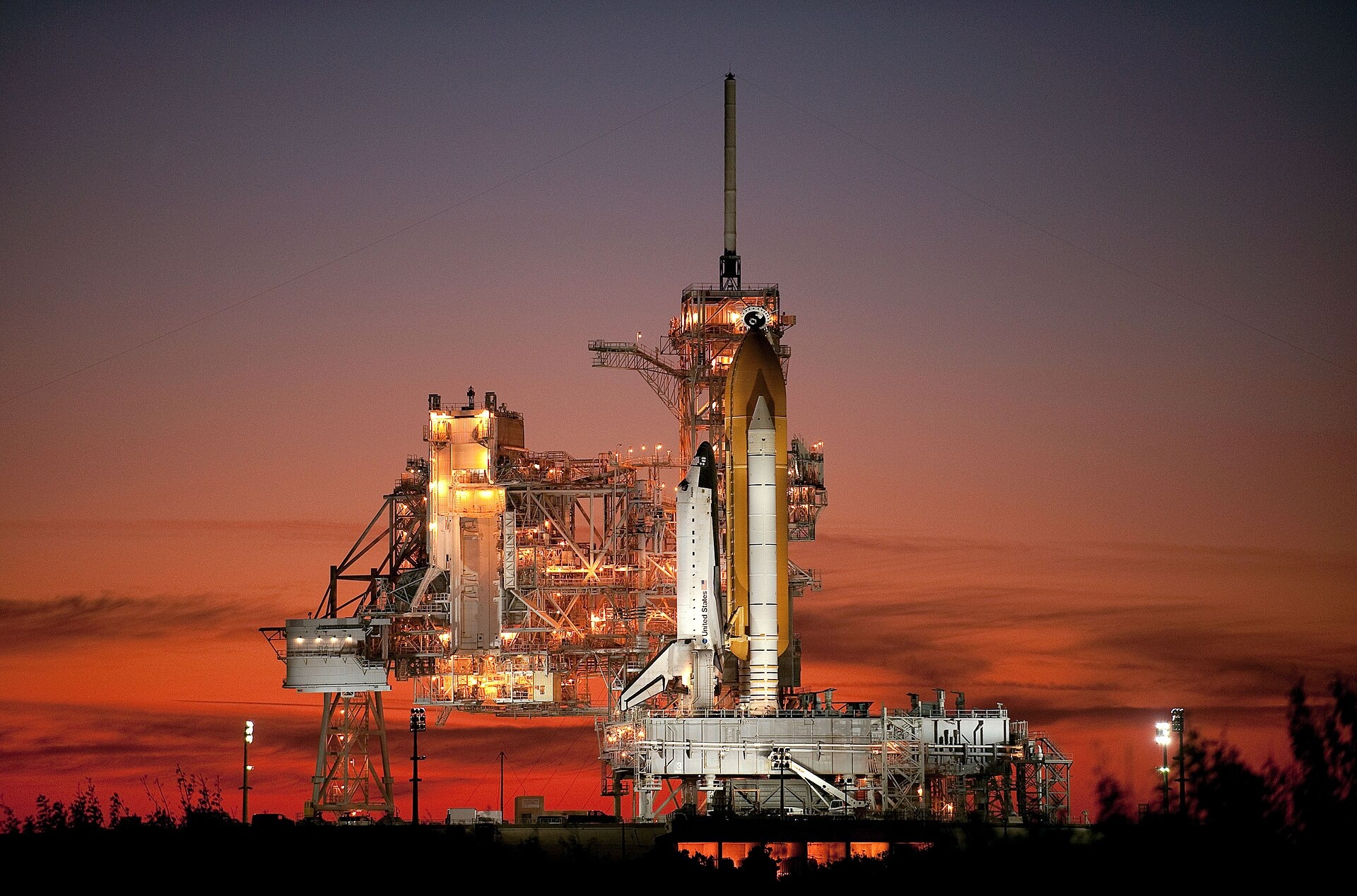
Source image · STS-129 Atlantis Ready to Fly · Bill Ingalls · Public domain · Original image and rights details ↗
Source image · PSO J318.5-22 Rouge 39x27 CMYK-1 · NASA/JPL-CalTech · Public domain · Original image and rights details ↗
Source image · NASA HQ Building · NASA · Public domain · Original image and rights details ↗