The Long Reign of the Ninth Planet
When Clyde Tombaugh first identified Pluto in 1930, it was hailed across the globe as the discovery of the solar system’s ninth planet [s1]. Orbiting billions of kilometers from the Sun in the frigid darkness beyond Neptune [s1], Pluto held that distinguished status for more than seven decades. Generational astronomy textbooks and classroom charts placed the remote world at the very edge of our planetary neighborhood, picturing it as a lonely sentinel marking the outer boundary of planetary architecture.
However, as observational technology advanced in the late twentieth and early twenty-first centuries, astronomers began to realize that the space beyond Neptune was far from empty. Telescopes detected a vast reservoir of icy bodies, comets, and primitive planetesimals—a region now known as the Kuiper Belt [s1]. This distant realm constitutes the solar system's third zone, following the inner terrestrial worlds and the middle realm of giant planets [s1]. The realization that Pluto was not an isolated oddity, but rather one of many similar icy objects orbiting in this belt, forced a profound scientific reevaluation.
In 2006, the International Astronomical Union (IAU) formally adopted a rigorous definition for what constitutes a planet [s1]. Under these revised criteria, a celestial body must orbit the Sun, possess sufficient mass for its self-gravity to pull it into hydrostatic equilibrium (a nearly round shape), and clear the neighborhood around its orbit. Because Pluto shares its orbital territory with an extensive swarm of Kuiper Belt objects, it failed to meet the third requirement. The IAU officially reclassified Pluto as a dwarf planet [s1]. While the decision sparked spirited public debate and planetary nostalgia, it reflected a major conceptual shift: Pluto was no longer just the smallest outlier of the major planets, but the premier ambassador to an uncharted third domain of our solar system.
Encounter at the Edge: The 2015 Flyby
Despite decades of telescopic study from Earth and near-Earth orbit, Pluto remained little more than a blurry cluster of pixels. Its diminutive size and vast distance presented an insurmountable barrier for detailed spectroscopy and imaging. Understanding the true nature of this distant dwarf planet required sending a dedicated probe across the solar system.
That opportunity arrived with NASA's New Horizons mission, launched to perform the first in-depth exploration of Pluto and the Kuiper Belt. On July 13 and 14, 2015, the spacecraft made history by completing the first close flyby of the Pluto system [s1]. Traveling at immense velocity, New Horizons gathered high-resolution imagery, spectroscopic maps, and atmospheric measurements, capturing views that nearly filled the frame of its instruments [s1].
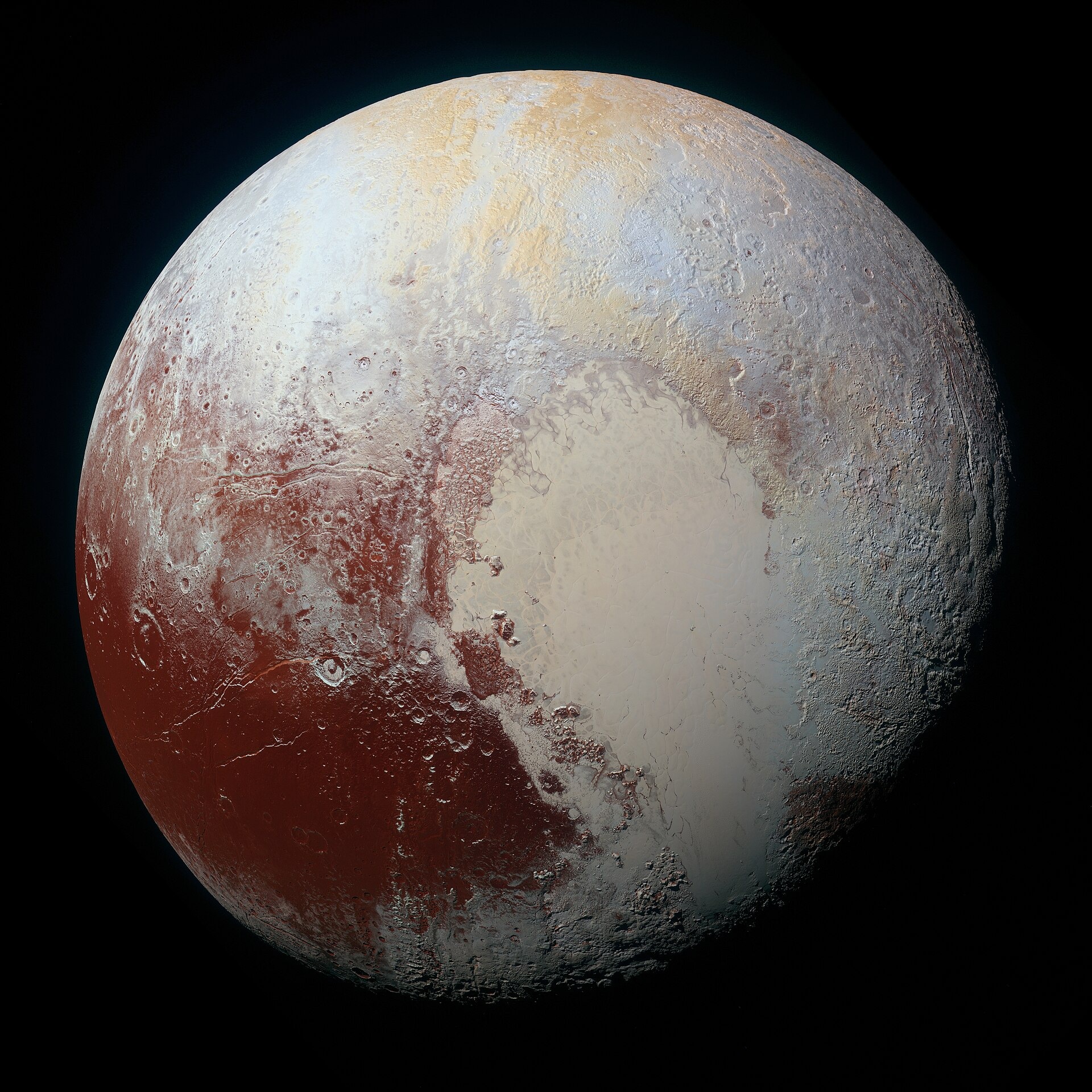
The encounter marked humanity's first direct reconnaissance of the Kuiper Belt [s1]. Rather than encountering a static, crater-saturated relic frozen in time, scientists were stunned to discover a visually spectacular and geologically varied landscape. New Horizons imaged vast plains of nitrogen and volatile ices, rugged water-ice mountain ranges towering kilometers into the hazy sky, and complex glacial flow patterns. In a single historic sweep, the flyby shattered the long-held assumption that small, frozen worlds far from solar heat must be geologically inert. Instead, New Horizons established that dwarf planets can host dynamic atmospheric cycles, intricate surface chemistries, and ongoing geological evolution [s1].

A Binary Architecture: Charon and the Four Moonlets
One of the most remarkable aspects of Pluto unveiled in detail by New Horizons is its intricate moon system. Pluto does not travel through the Kuiper Belt alone; it is accompanied by five known natural satellites: Charon, Styx, Nix, Kerberos, and Hydra [s1].
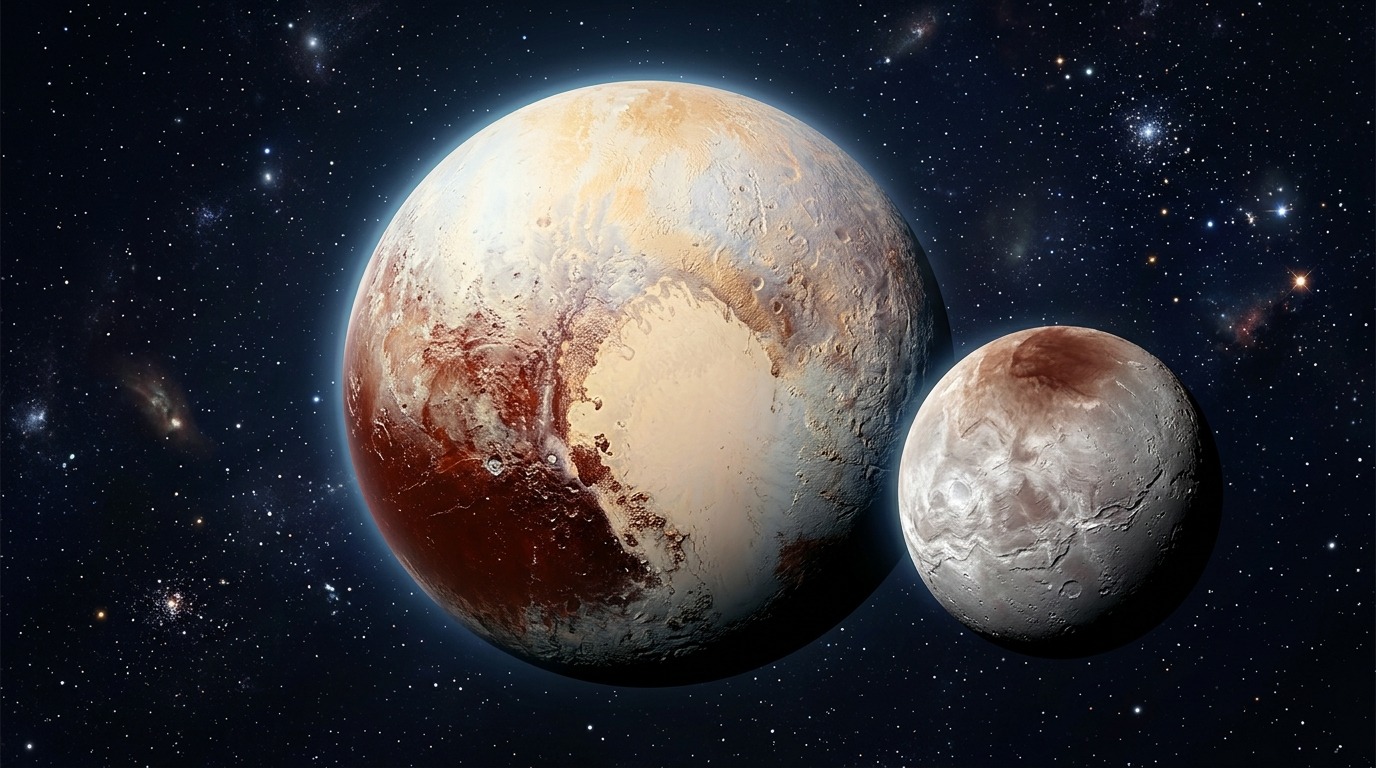
Charon, discovered in 1978 and observed up close in 2015, is the system’s dominant secondary world. Charon measures approximately half the diameter of Pluto itself, making it the largest known moon relative to its parent planet anywhere in the solar system [s1]. Because Charon is so massive in proportion to Pluto, the two bodies do not simply orbit a point inside Pluto’s physical sphere. Instead, their center of mass—the barycenter—lies in the open space between them. This unique orbital configuration leads many planetary scientists to regard Pluto and Charon as a true binary system.
During the 2015 flyby, New Horizons captured striking composite imagery showing Charon alongside the four smaller moons [s1]. Where Charon displays deep canyons, tectonic fractures, and a reddish polar cap, its four tiny siblings—Styx, Nix, Kerberos, and Hydra—are irregular, highly reflective shards of ice tumbling in chaotic orbits around the central binary pair [s1]. Spectral and orbital analyses have shed light on how this multi-body system formed, suggesting that a catastrophic collision early in solar system history likely blasted debris into orbit, which subsequently coalesced into Charon and the surrounding quartet of smaller moons.
The Mystery of Surface Liquids and Internal Heat
Among the most surprising revelations delivered by New Horizons was evidence suggesting recent liquid activity on or just beneath Pluto's surface [s1]. For an object whose surface temperature hovers near 40 Kelvin (-233 degrees Celsius), the presence or recent mobility of liquids presented a formidable scientific puzzle.
Planetary researchers continue to analyze the precise mechanisms that could drive such activity. In classical planetary models, small bodies like Pluto should have exhausted their primordial heat of accretion billions of years ago. Without tidal heating from a giant gas planet, maintaining warm internal conditions is exceptionally challenging. Scientists hypothesize that the slow radioactive decay of trace elements within Pluto's rocky core, combined with an insulating layer of volatile ice clathrates, might preserve a liquid water-ammonia ocean beneath its outer shell.
However, significant uncertainties remain regarding the exact drivers, nature, and timing of any surface liquids or cryovolcanic processes. Whether cryolavas of water, methane, or ammonia mixtures have breached the surface within recent geological epochs continues to be actively debated. The discovery underscored that scientists do not yet fully understand the long-term thermal and structural evolution of icy dwarf planets in the Kuiper Belt, leaving open pivotal questions about whether subsurface oceans can persist at the solar system's frigid perimeter.
The Enduring Legacy of Pluto's Exploration
A decade after New Horizons opened the door to the Kuiper Belt, Pluto remains a touchstone for comparative planetology. Its reclassification from a primary planet to a dwarf planet, far from diminishing its importance, placed it at the forefront of an expansive new category of worlds that populate the outer solar system.
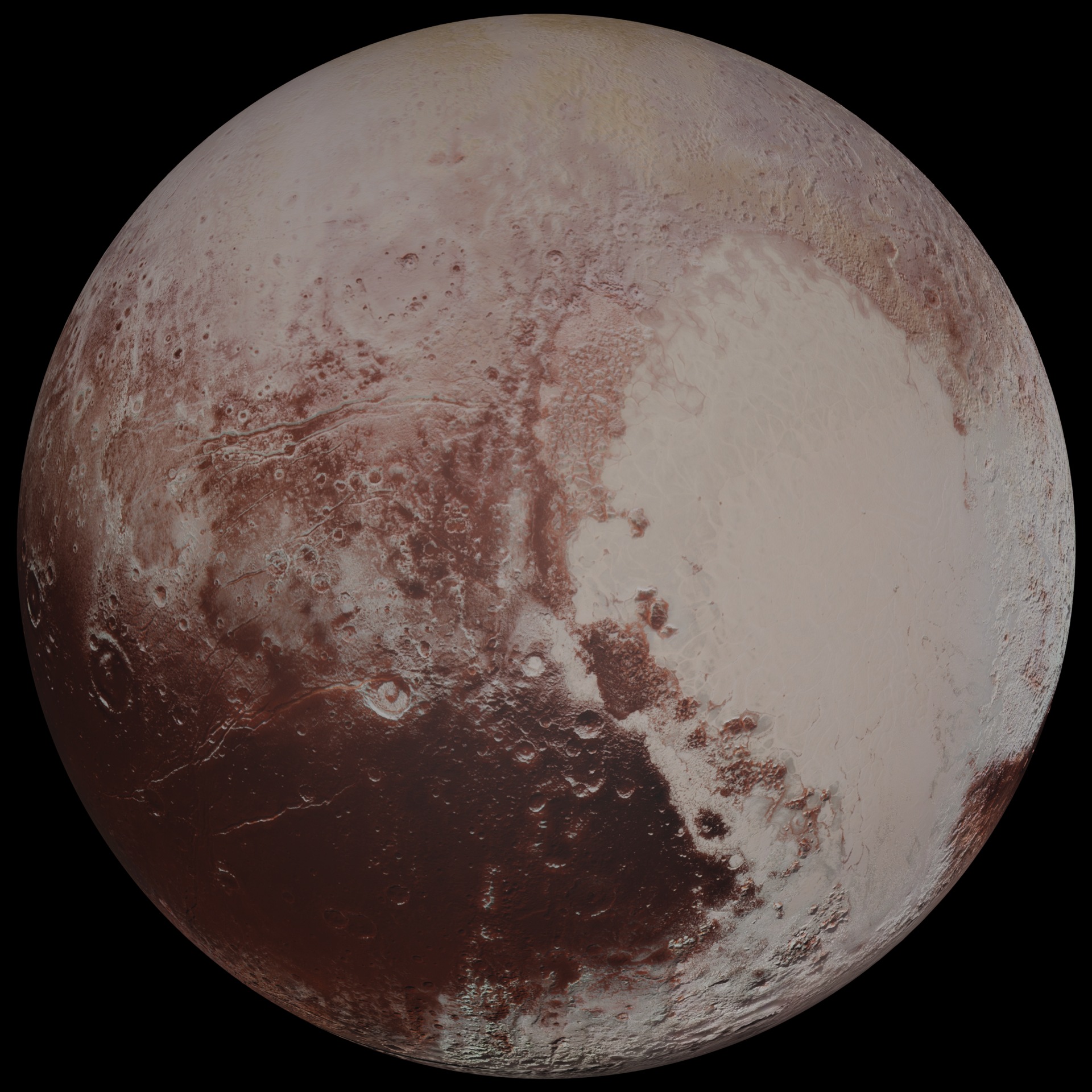
The legacy of the 2015 flyby continues to shape modern planetary science. The New Horizons mission demonstrated that dwarf planets are not mere debris left over from the formation of the gas giants, but sophisticated planetary bodies with atmospheric hazes, complex chemical cycles, multi-satellite architectures, and ongoing tectonic activity [s1]. As researchers refine their models of outer solar system chemistry, the data gathered during that brief encounter serves as our primary ground truth for the thousands of icy worlds orbiting in the distant dark.
Future exploration will eventually be necessary to resolve the deepest questions left by New Horizons. Scientists look forward to future proposed missions—such as dedicated orbiters or atmospheric probes—that could linger in the Pluto-Charon system, measure gravitational anomalies, probe the potential subsurface ocean, and chart the seasonal cycles of its nitrogen atmosphere over decades. Until those spacecraft set sail, Pluto stands as a monument to scientific discovery: a small, vibrant world that defied expectations and redefined how we view the boundaries of our solar neighborhood.

Sources & further reading
[s1] Pluto ↗science.nasa.gov
Updated 18/10/2026. Report a correction.Image credits
Source image · Global LORRI mosaic of Pluto in true colour · NASA/JHUAPL/SwRI · Public domain · Original image and rights details ↗
Source image · Pluto-01 Stern 03 Pluto Color TXT · NASA / Johns Hopkins University Applied Physics Laboratory / Southwest Research Institute · Public domain · Original image and rights details ↗
Source image · Pluto Blender render · Wikideas1 · CC0 · Original image and rights details ↗
Source image · Pluto in True Color - High-Res · NASA/Johns Hopkins University Applied Physics Laboratory/Southwest Research Institute/Alex Parker · Public domain · Original image and rights details ↗
Source image · Pluto in True Color - High-Res · NASA/Johns Hopkins University Applied Physics Laboratory/Southwest Research Institute/Alex Parker · Public domain · Original image and rights details ↗