The Discovery and Naming of the Ninth Planet
In March 1930, astronomers at the Lowell Observatory announced the discovery of a distant world traversing the outer boundaries of the known solar system. The discovery captured global imagination, prompting international intrigue over what to call this dim, slow-moving wanderer. The name Pluto was originally suggested by an eleven-year-old schoolgirl in Oxford, England, named Venetia Burney [s1]. Over breakfast with her grandfather, Falconer Madan, on March 14, 1930, she proposed naming the celestial body after the Roman god of the underworld [s1]. Madan forwarded her suggestion to the Lowell Observatory, where it was formally selected [s1].
For seventy-six years following its discovery, Pluto was popularly recognized across textbooks, culture, and astronomical literature as the solar system's ninth planet [s1]. Orbiting at an average distance of roughly 3.7 billion miles (5.9 billion kilometers) from the Sun—nearly 39 times the distance between Earth and our central star—it remained an enigma shrouded by distance [s1]. At that remote vantage, sunlight takes 5.5 hours to reach the diminutive world, shining at only 1/900th of its terrestrial midday brilliance [s1]. To mid-century astronomy, Pluto was an outlier among giant outer planets like Jupiter and Saturn, yet its planetary status remained broadly unquestioned because no other comparable bodies had been identified in its remote orbital realm.
A Shifting Frontier: Uncovering the Kuiper Belt
The taxonomic foundation supporting Pluto began to fracture during the late twentieth century as observational astronomy underwent a technological revolution. Improved charge-coupled device detectors and wide-field astronomical surveys revealed that the void beyond Neptune was far from empty. Instead, astronomers discovered that Pluto resided within a vast, ring-shaped reservoir of ancient icy debris: the Kuiper Belt [s1].
This distant region is populated with thousands of miniature icy worlds that condensed roughly 4.5 billion years ago during the dawn of the solar system [s1]. As observers systematically cataloged this region, they uncovered dozens of trans-Neptunian objects with physical compositions, densities, and orbital dynamics resembling Pluto's own. It became clear that Pluto was not an isolated planetary giant holding dominion over an empty frontier, but rather one member of an extensive population of icy planetesimals [s1].
The discovery of other similar worlds deeper in the Kuiper Belt directly forced the international astronomical community to reassess whether every newly located icy sphere should be designated a major planet or if a more rigorous scientific taxonomy was required [s1]. Had Pluto retained its historical status without a formalized standard, the solar system could have quickly expanded to encompass dozens or hundreds of recognized planets as deep telescopic surveys identified more trans-Neptunian bodies.

The 2006 IAU Resolution and the Definition of a Planet
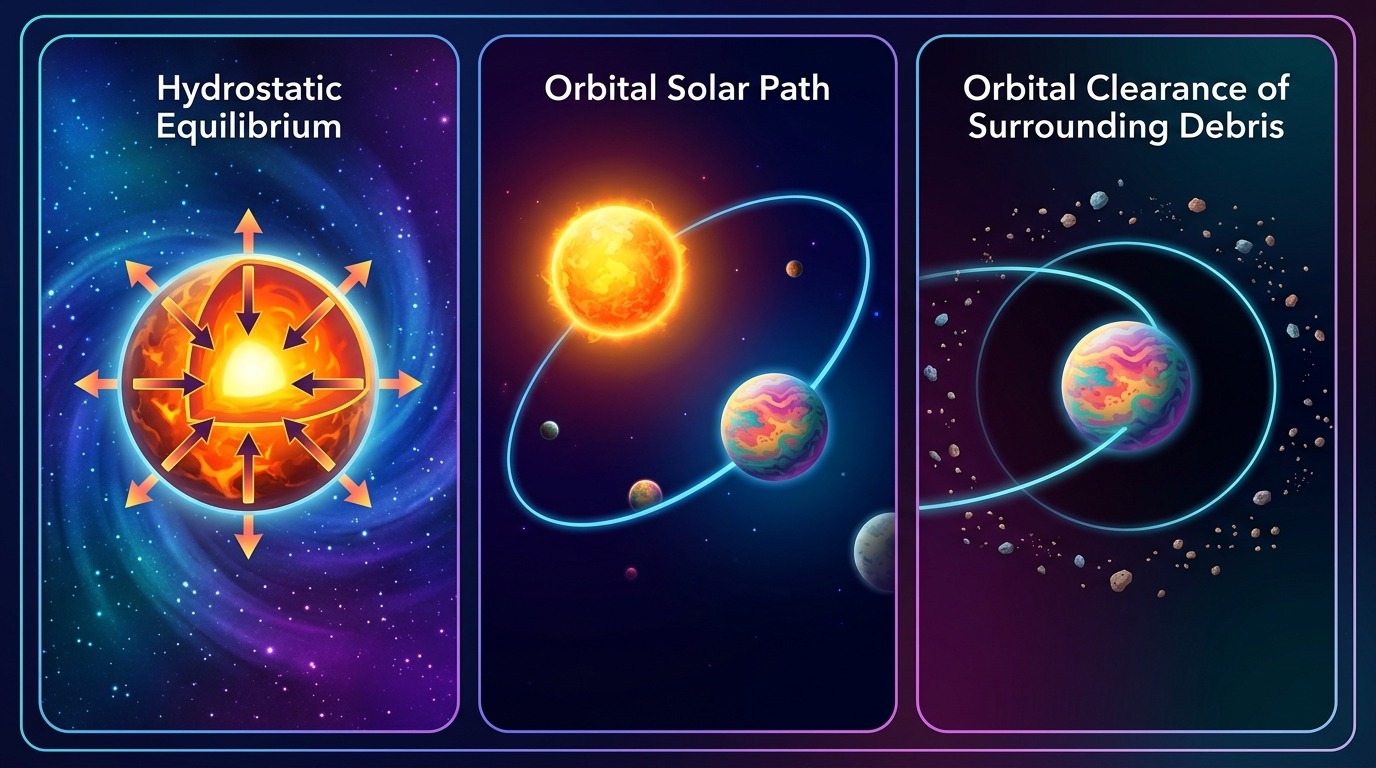
To resolve this mounting taxonomic crisis, the International Astronomical Union convened at its General Assembly in Prague in August 2006 [s1]. Astronomers sought to replace subjective historical convention with an objective, physically and dynamically grounded definition of planethood. The resulting IAU Resolution established three strict criteria that a celestial body must satisfy to be classified as a full planet in our solar system [s1].
First, the object must be in direct orbit around the Sun, excluding natural satellites orbiting larger parent worlds [s1]. Second, the body must possess sufficient mass for its self-gravity to overcome rigid body forces, achieving hydrostatic equilibrium and pulling itself into a nearly round shape [s1]. Third, the body must clear the neighborhood around its orbit of debris [s1].
Pluto easily satisfies the first two conditions: it orbits the Sun directly and possesses enough gravitational pull to mold its 1,477-mile-wide (2,377-kilometer-wide) body into a sphere [s1]. However, Pluto failed the third criterion [s1]. Because Pluto is situated within the trans-Neptunian zone where thousands of other icy bodies orbit and potentially cross its trajectory, it has not gravitationally cleared its orbital path [s1]. Under the 2006 IAU resolution, the union defined a dwarf planet as a celestial body that orbits the Sun, achieves hydrostatic equilibrium, but has not cleared its orbit [s1]. Pluto was consequently reclassified into this new designation alongside comparable trans-Neptunian bodies [s1].
Orbital Dynamics and the Architecture of Pluto's Realm
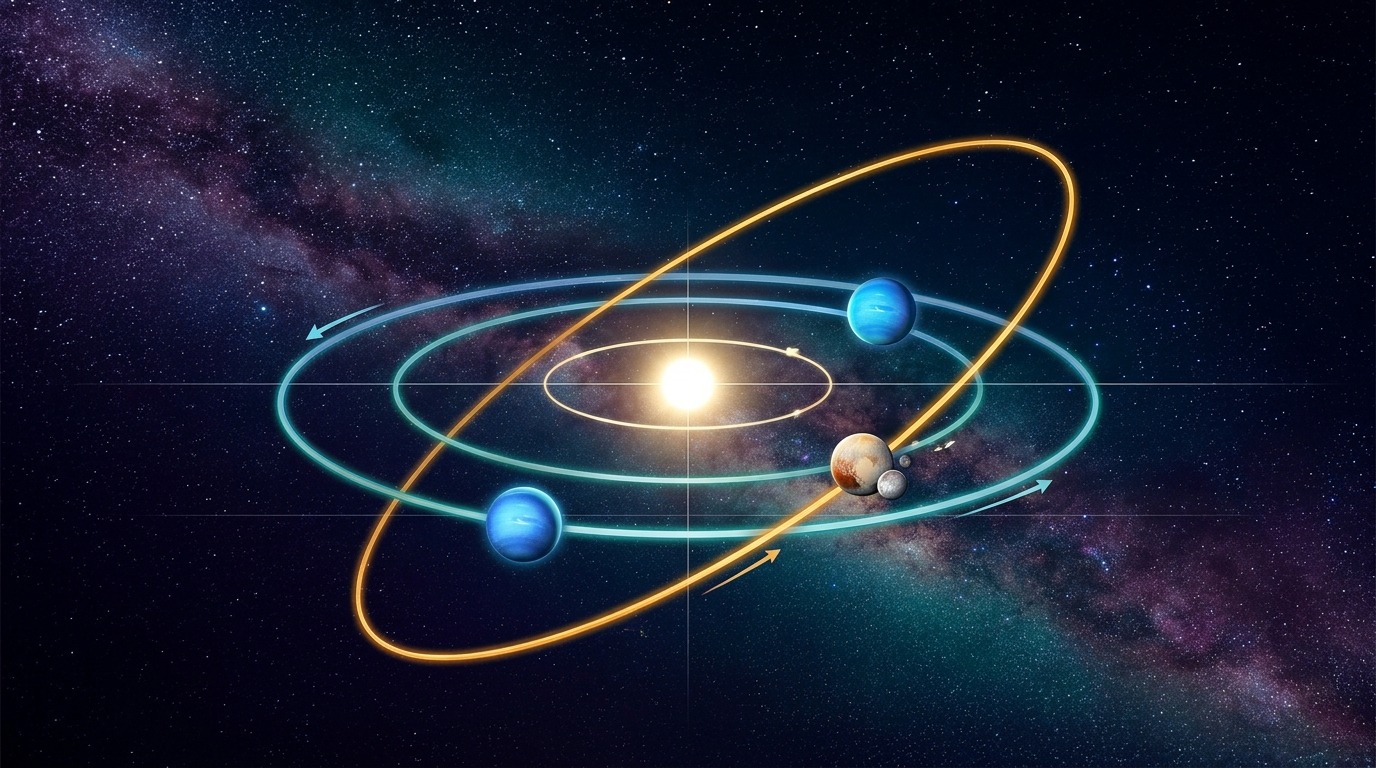
The physical and dynamical properties of Pluto underline why it fails the orbital-clearing threshold. Pluto follows an eccentric, 248-year-long elliptical orbit that takes it as far as 49.3 astronomical units from the Sun at aphelion and as close as 30 astronomical units at perihelion [s1]. This oval trajectory is inclined by 17 degrees relative to the primary ecliptic plane of the solar system. For a twenty-year stretch between 1979 and 1999, Pluto was actually closer to the Sun than the ice giant Neptune [s1].
Pluto's planetary mass is also small relative to the surrounding bodies in its neighborhood. With an equatorial diameter about one-fifth that of Earth and a mass roughly one-sixth that of Earth's Moon, Pluto lacks the gravitational dominance to sweep away, assimilate, or fling outward the debris sharing its orbital corridor [s1].
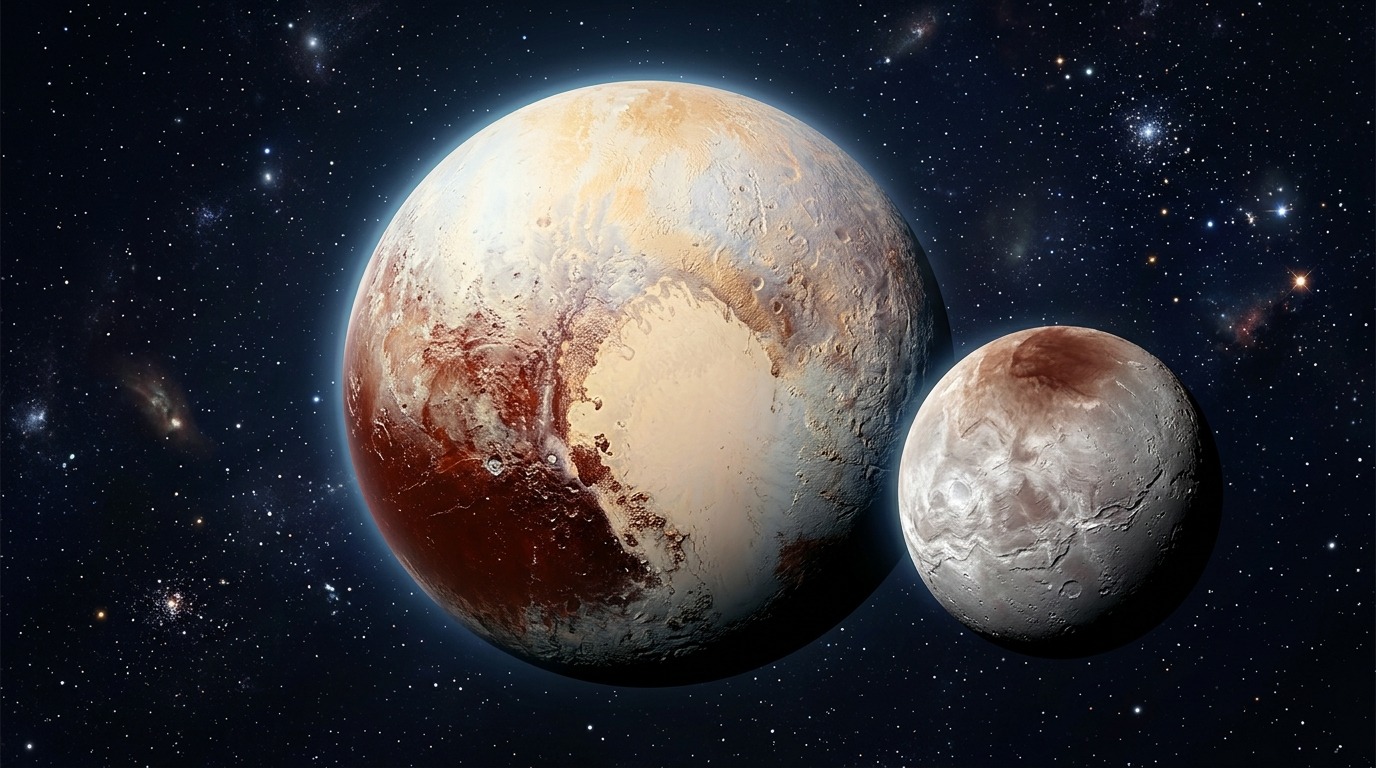
Furthermore, Pluto exists in a complex gravitational system with its five known moons: Charon, Nix, Hydra, Kerberos, and Styx [s1]. The largest moon, Charon, is roughly half the diameter of Pluto itself, making it the largest satellite relative to the planet it orbits in our solar system [s1]. Charon's orbit around Pluto takes 153 hours – the same time it takes Pluto to complete one rotation [s1]. This means Charon neither rises nor sets, but hovers over the same spot on Pluto's surface [s1]. The same side of Charon always faces Pluto, a state called tidal locking [s1]. This unique orbital architecture, often described as a double planet system, highlights how Pluto operates as part of an intricate outer solar system collective rather than a solitary, dominant world [s1].
New Horizons and the Reality of a Living World
While the 2006 reclassification altered Pluto's taxonomic category, it in no way diminished its scientific significance. In July 2015, NASA's New Horizons spacecraft conducted the first close-up exploration of Pluto and its satellite system, sweeping within 7,800 miles of the dwarf planet's surface [s1]. The data returned by the flyby revolutionized planetary geology, revealing a far more active and dynamic world than many astronomers had anticipated.
Rather than a stagnant, heavily cratered relic, New Horizons discovered towering mountains of pure water ice reaching heights of 6,500 to 9,800 feet (2 to 3 kilometers), valleys stretching over 370 miles (600 kilometers), and vast plains of frozen nitrogen exhibiting convective churn [s1]. The probe captured evidence of ongoing cryovolcanic and tectonic processes resurfacing the dwarf planet, alongside a tenuous, layered atmosphere composed primarily of nitrogen, methane, and carbon monoxide that expands and contracts as Pluto moves through its seasonal cycle [s1].
Though average surface temperatures plunge between -375 and -400 degrees Fahrenheit (-226 to -240 degrees Celsius), internal heat may support a warm interior and potentially even a liquid ocean beneath Pluto's icy mantle [s1]. Pluto's reclassification did not demote its complexity; instead, it marked the beginning of a richer understanding of the countless miniature icy worlds that populate the solar system's distant frontier.

Sources & further reading
[s1] Pluto: Facts - NASA Science ↗science.nasa.gov
Updated 16/10/2026. Report a correction.