The Subtle Mechanics of Quark Flavour Transitions
The Standard Model of particle physics remains humanity's most thoroughly tested description of the subatomic realm, cataloguing the elementary particles and three of the four fundamental forces that govern them. Within this theoretical architecture, quarks are organized into three distinct generations and six distinct flavours: up, down, charm, strange, top, and beauty (also referred to as bottom). Under ordinary conditions, quarks retain their flavour identity when interacting via the strong or electromagnetic forces.
Flavour transitions—processes wherein a quark shifts from one species to another—can occur solely through the mediation of the weak interaction, the fundamental force responsible for radioactive decay [s1]. Because these transformations violate flavour conservation, they provide an extraordinarily sensitive gauge for probing the underlying structure of physical law. In the quantum realm, transitions between states are not strictly isolated events; they are fundamentally shaped by quantum fluctuations, allowing virtual particles that do not appear in the final observable state to exert subtle, detectable influences on the decay's dynamics [s1]. By measuring the precise probabilities and geometric features of these shifts, physicists can search for footprints left by hypothetical particles that cannot yet be produced directly in colliders.
A One-in-Ten-Million Quantum Window
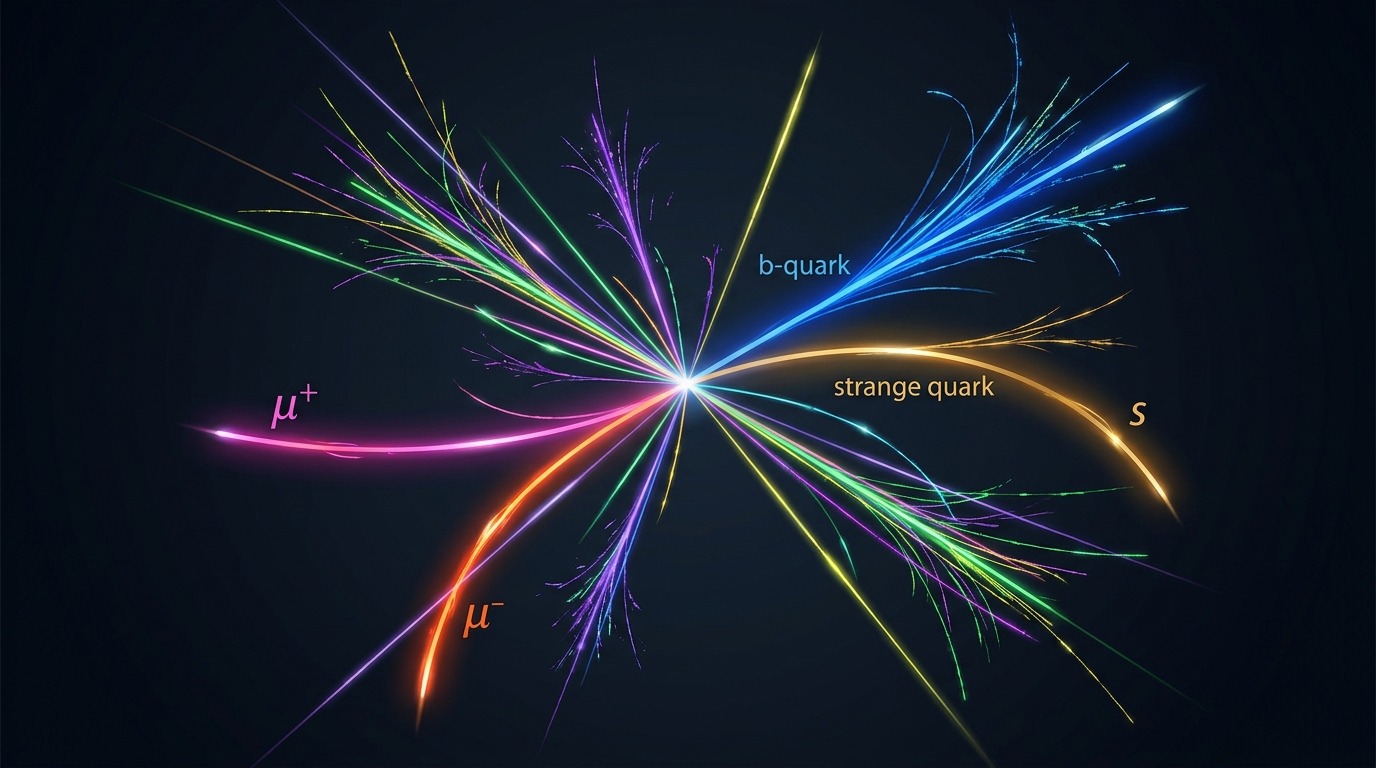
Among the vast array of subatomic decay channels, the transformation of a beauty quark into a strange quark accompanied by a muon and an antimuon—denoted shorthand as b→sμ+μ–—stands out as an exceptionally sensitive proving ground [s1]. This specific transition is extraordinarily rare: experimental and theoretical estimates establish that it occurs approximately once in every ten million decays of particles containing beauty quarks, commonly termed beauty particles [s1].
Because tree-level flavour-changing neutral currents are forbidden in the Standard Model, the b→sμ+μ– transition must proceed through higher-order quantum loops involving the exchange of multiple virtual particles, such as W bosons and top quarks [s1]. The extreme scarcity of this process means that even minute contributions from hypothetical, undiscovered bosons, leptoquarks, or novel forces could alter the expected decay rates or the spatial trajectory of the daughter particles. Over the past decade, experimental observations collected at particle colliders have repeatedly registered subtle anomalies, indicating that this transition might not behave exactly as Standard Model equations forecast [s1]. These lingering irregularities have turned beauty quark decays into one of the most closely watched frontiers in fundamental physics.
CMS Performs First Simultaneous Six-Channel Decay Study
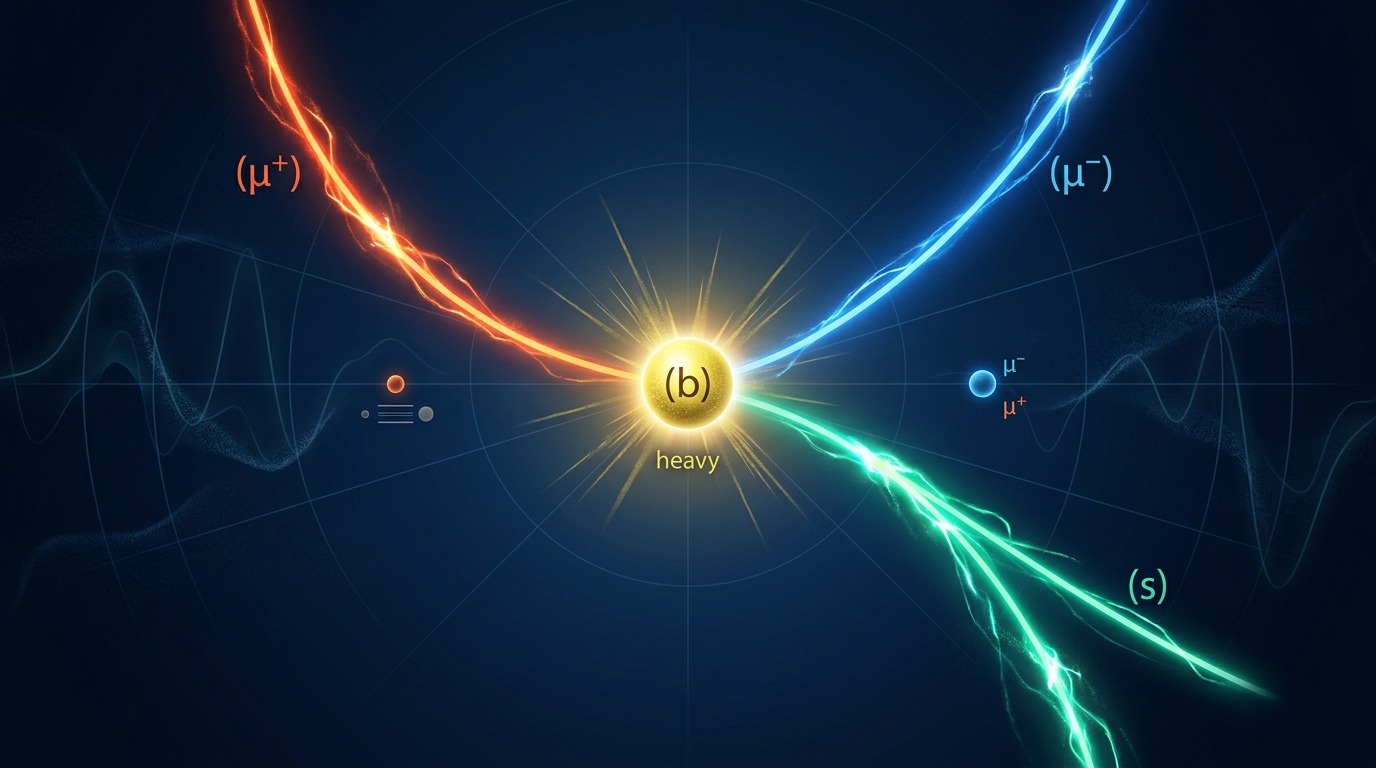
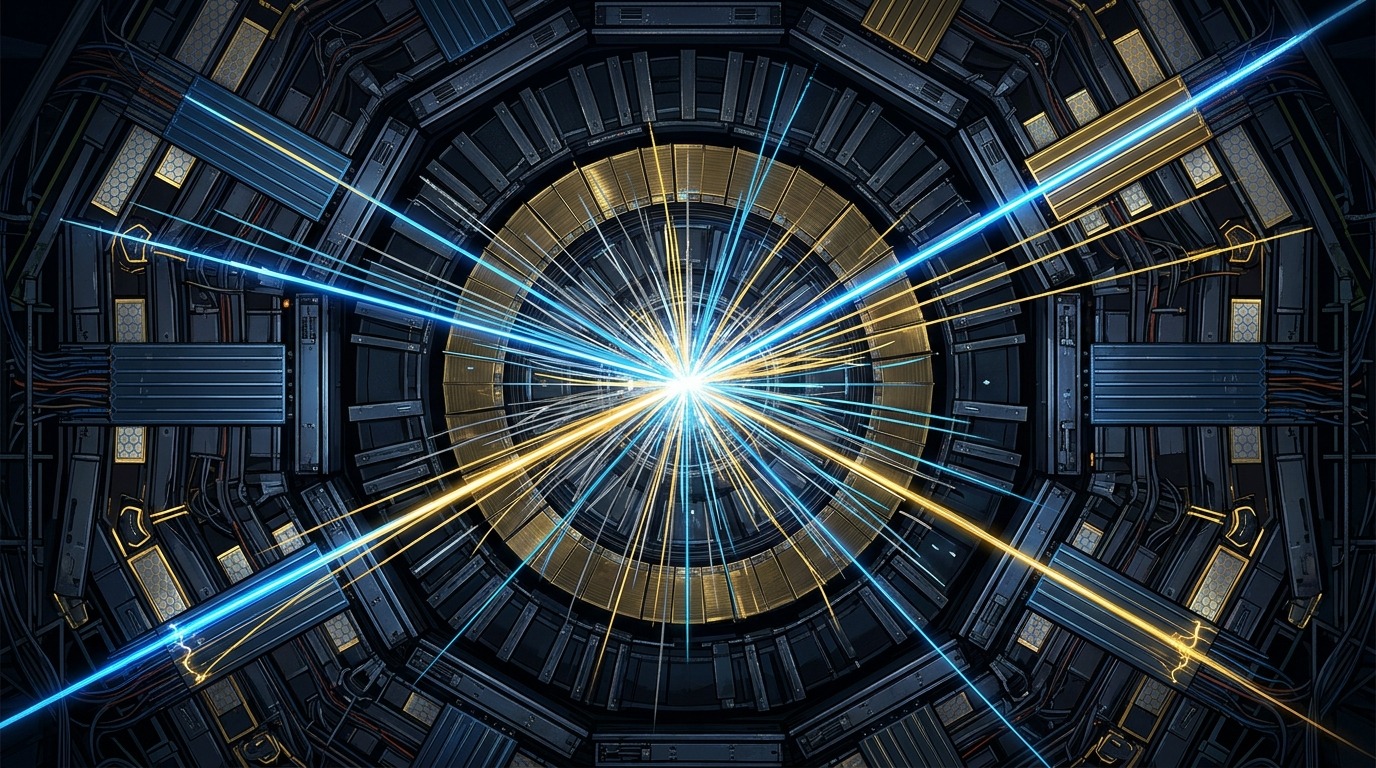
At the recent International Conference on High Energy Physics (ICHEP), the CMS Collaboration presented a major new investigation into the b→sμ+μ– transition, leveraging collision data gathered during LHC Run 3 [s1]. Rather than isolating a single decay pathway, CMS carried out the first simultaneous analysis across six distinct decay types involving beauty particles transforming into strange quarks alongside muon-antimuon pairs [s1].
Measuring the branching fraction—the fraction of total decays that proceed via a given channel—across multiple modes simultaneously represents a substantial methodological advance [s1]. This comprehensive approach allowed researchers to treat shared background signals and experimental systematic uncertainties consistently across all six channels, drastically reducing independent calibration errors [s1]. CMS achieved this precision in part by deploying a dedicated new software trigger during Run 3, enabling the experiment to record a significantly larger sample of beauty decays with unprecedented statistical accuracy [s1].
The resulting measurements revealed that while the difference between the observed branching fraction and the Standard Model expectation for each individual decay mode remained modest, the shift was notably consistent across all six decay channels [s1]. Such uniform discrepancies across independent decay topologies make it far less likely that the deviation arises from an isolated statistical fluke in a single channel, reinforcing the impetus to scrutinize these rare transitions further.
LHCb Probes Decay Geometry and the P5' Observable
Complementing the rate measurements from CMS, the LHCb Collaboration unveiled new findings focused on the spatial kinematics of beauty meson decays [s1]. Working with data recorded during the first and second runs of the Large Hadron Collider, LHCb investigated the decay of a neutral beauty meson (B0), which hosts an antibeauty quark, into an excited kaon (K*) containing a strange quark, accompanied by a muon and an antimuon (B0→K*μ+μ–) [s1].
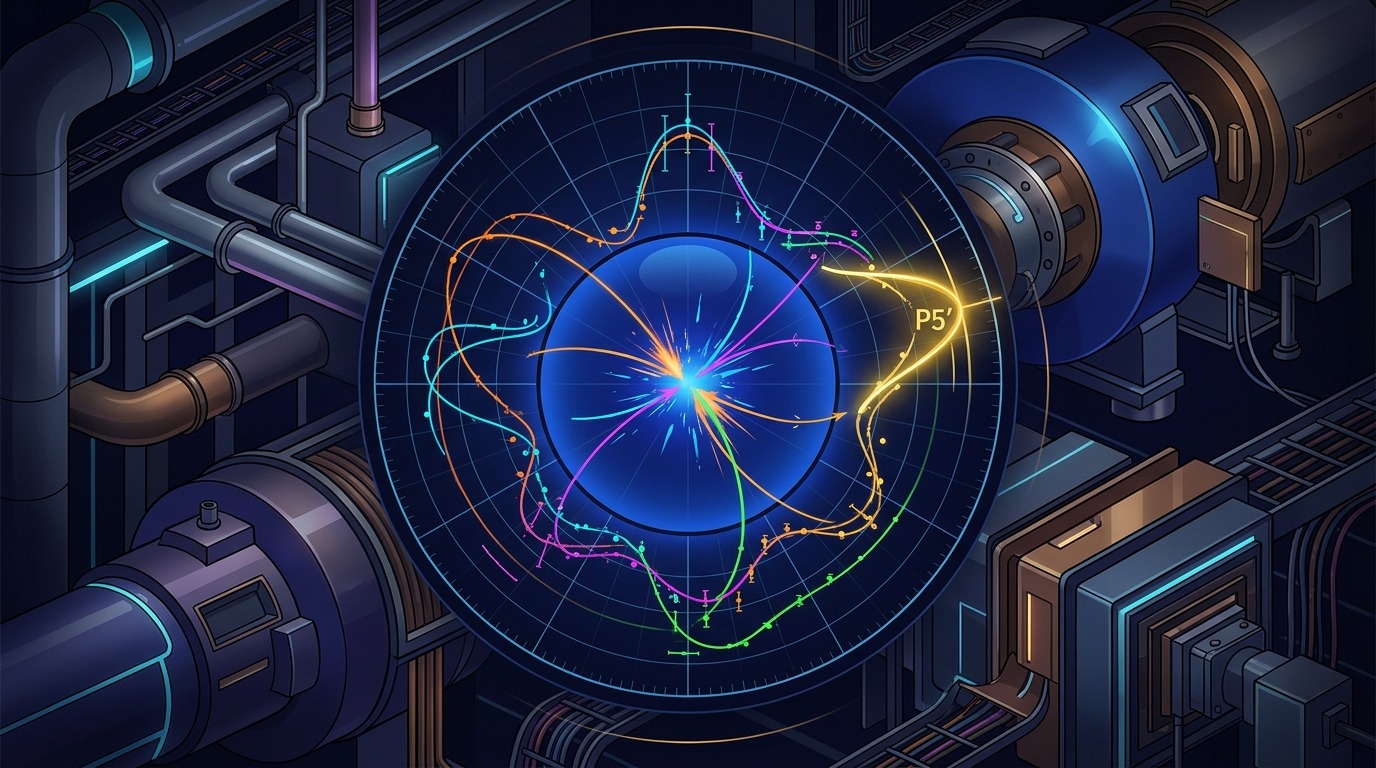
Rather than focusing solely on how often the decay takes place, LHCb physicists evaluated an angular observable designated as P5' [s1]. The P5' parameter describes the complex three-dimensional angles at which the final-state particles fly apart following the meson's disintegration [s1]. Angular distributions are especially potent diagnostic tools because theoretical predictions of these relative angles are often less vulnerable to hadronic uncertainties that can obscure branching fraction calculations.
To extract this parameter, the LHCb team implemented a novel, model-independent analytical technique [s1]. In particle physics, a model-independent analysis deliberately avoids imposing theoretical assumptions about the specific physical mechanisms or novel particles that might participate inside the decay loop [s1]. The resulting measurement confirmed a slight difference when compared against Standard Model expectations, sustaining the intriguing pattern of tensions that has captured the attention of flavour physicists for years [s1].
Navigating Uncertainties on the Path to Discovery
The parallel findings from CMS and LHCb demonstrate the dual utility of combining decay rate measurements with precise angular profiling [s1]. Where CMS identified consistent small discrepancies in branching fractions across six separate decay channels, LHCb confirmed subtle geometric tensions in the angular signature of B0→K*μ+μ– [s1].
Despite the consistency of these observations, physicists emphasize that the current evidence remains far from conclusive [s1]. The measured deviations are subtle, and the complexities of strong-force interactions within composite particles mean that theoretical predictions carry their own non-trivial uncertainties. Definitive confirmation of whether these subtle anomalies stem from novel fundamental particles—or represent poorly understood Standard Model hadronic effects—demands substantially larger statistical datasets and refined theoretical modeling [s1].
The immediate future of flavour physics will pivot on LHC Run 3 data [s1]. LHCb researchers are currently preparing to fold their vast Run 3 dataset into the P5' analysis and expand their model-independent framework across other b→sμ+μ– decay topologies [s1]. Paired with the advanced triggering capabilities and accumulated luminosity of CMS, upcoming analyses will provide the sharpest tests yet of beauty quark transitions, determining whether these tantalising whispers are the dawn of a new era in fundamental physics [s1].
Sources & further reading
[s1] Studying beautiful flavour transitions – Home | CERN ↗home.cern · 2026-10-14
Updated 15/10/2026. Report a correction.