Passing the Environmental Gauntlet at JPL
Before any robotic spacecraft can embark across cislunar space, it must prove its resilience against the punishing physics of spaceflight. In late September 2026, Voyager Technologies’ commercial Griffin-1 lunar lander concluded nearly three months of exhaustive environmental qualification testing at NASA’s Jet Propulsion Laboratory in Southern California [s1]. The intensive campaign verified that the lander’s structure, thermal control systems, and complex avionics can withstand the violent mechanical energies of liftoff, the vacuum of interplanetary transit, and the stark thermal realities of operating on the Moon [s1].
Operating under NASA’s Commercial Lunar Payload Services (CLPS) framework, commercial landers like Griffin-1 represent a cornerstone of contemporary lunar exploration [s1]. Unlike single-purpose institutional probes of past eras, commercial landers must accommodate diverse instrument suites while demonstrating structural integrity through standard space qualification protocols. By subjecting Griffin-1 to physical simulations of launch, spaceflight, and lunar touchdown, engineers at JPL—which is managed for NASA by Caltech—established that the spacecraft's foundational systems are flight-ready [s1].
Simulating Ascent: 153 Decibels and Dynamic Shaker Tests
The initial hurdles of any space mission involve surviving the mechanical assault of rocket propulsion. During ascent, rocket engines generate acoustic pressure waves that reverberate through the payload fairing, coupled with intense low-frequency vibrations transferred through the vehicle adapter. To evaluate Griffin-1's tolerance to these dynamics, engineers subjected the lander to specialized acoustic and shaker table tests at JPL [s1].
Inside a sealed acoustic chamber on August 12, giant horns powered by compressed gaseous nitrogen blasted Griffin-1 with sound levels climbing up to 153 decibels [s1]. This acoustic deluge simulated the tremendous sound pressure generated during liftoff, ensuring that delicate structural panels, antennas, and internal circuitry will not delaminate or shake loose under the acoustic loading of launch [s1].
Following acoustic qualification, Griffin-1 was transferred to a dynamic shaker table to assess its multi-axis structural response [s1]. Hundreds of telemetry sensors distributed across the lander captured real-time stress data as the table vibrated the craft in three orthogonal directions with escalating intensity [s1]. This multi-axis mechanical vibration regime validated that Griffin-1's load-bearing trusses, propellant tanks, and mounting hardware can absorb the mechanical shocks of staging, atmospheric ascent, and trans-lunar injection without mechanical degradation [s1].
Thermal Vacuum Trials in the 25-Foot Space Simulator
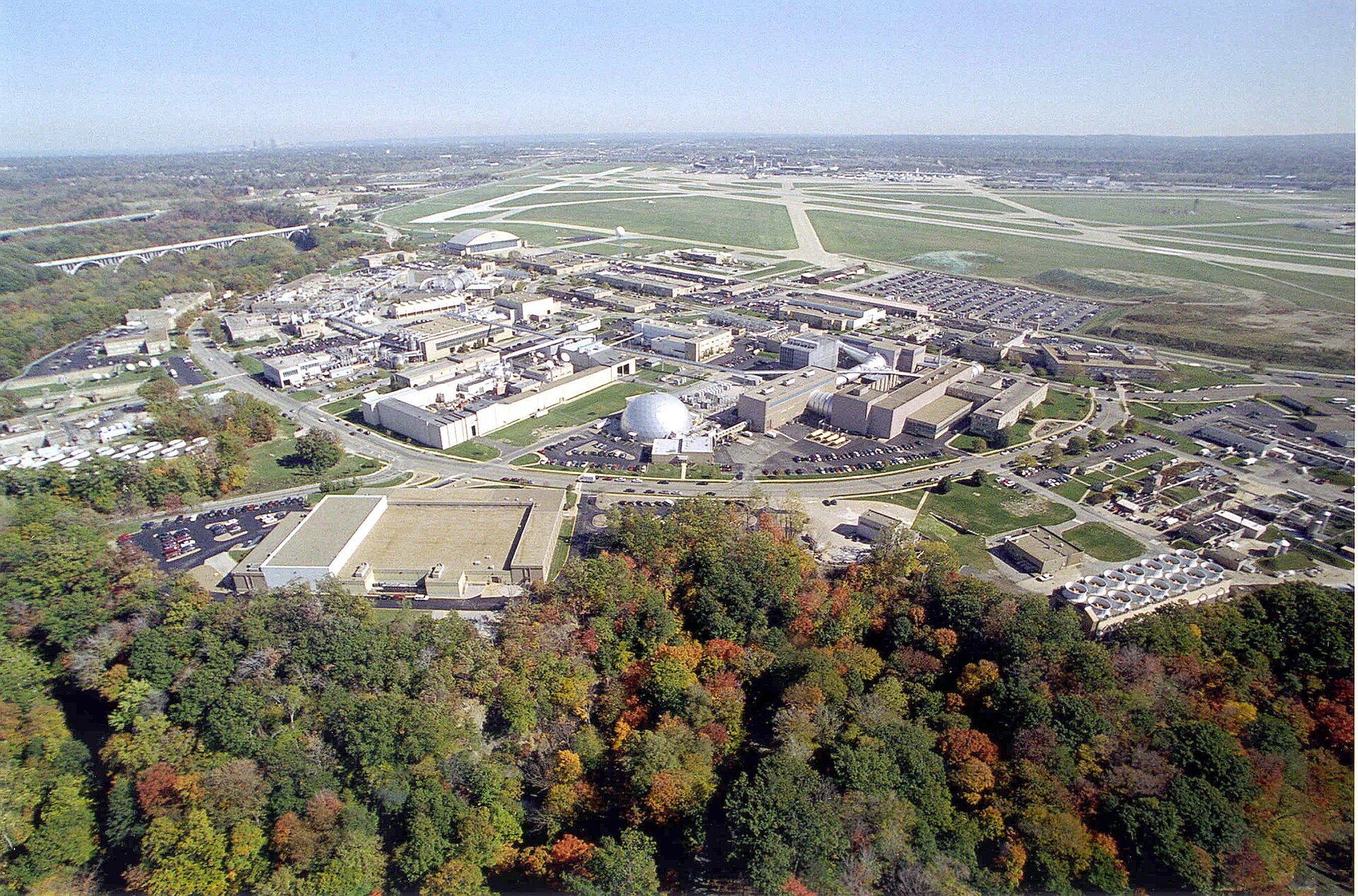
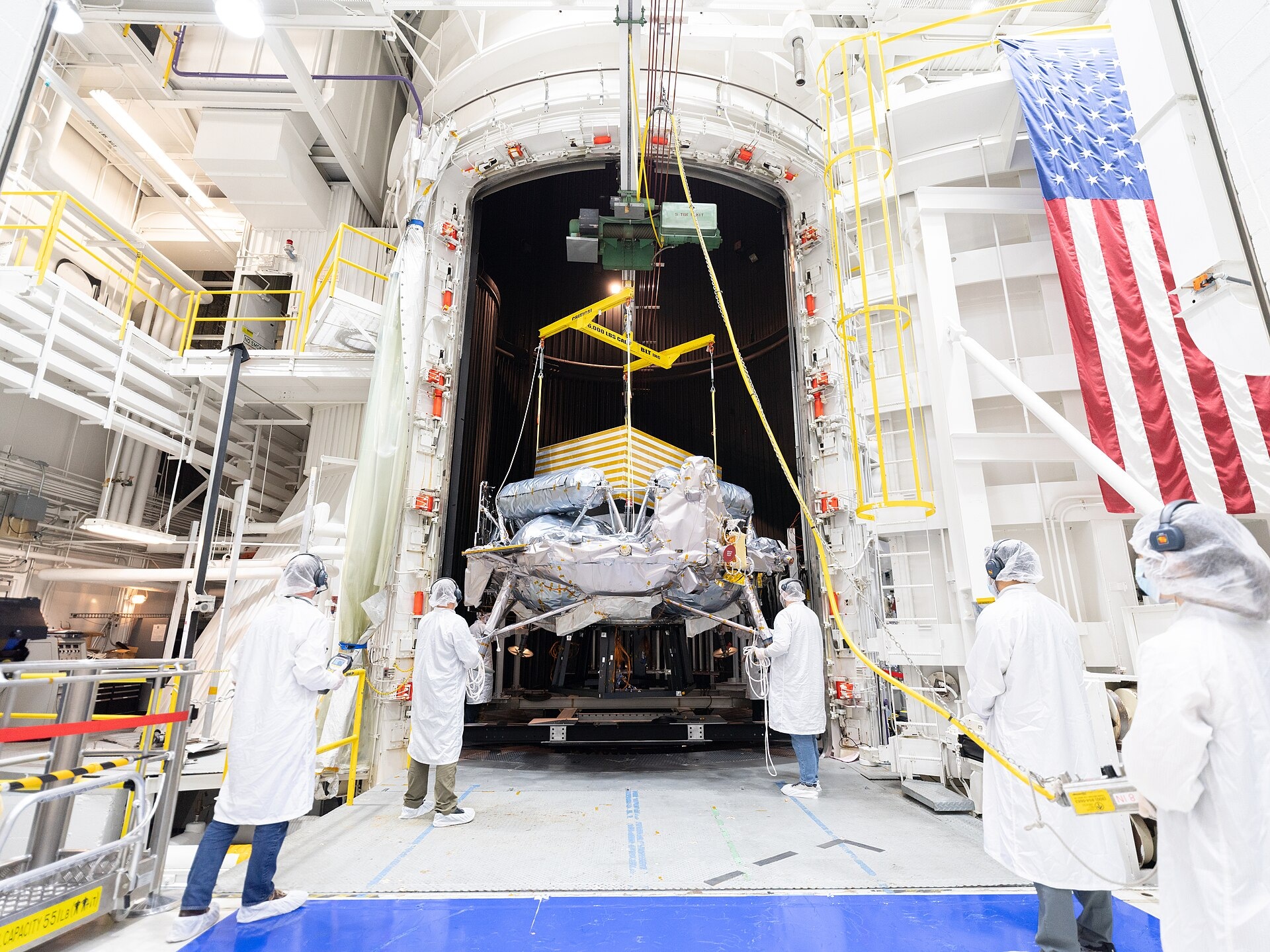
Once liberated from the atmosphere, a spacecraft leaves behind convective cooling, entering a domain governed solely by radiative heat transfer and direct conductive paths. In space, surfaces exposed to the Sun absorb intense solar irradiance, while shadowed facets radiate thermal energy into the near-absolute-zero void. To simulate these conditions, engineers transferred Griffin-1 to JPL's historic 25-Foot Space Simulator on August 31, 2026 [s1].
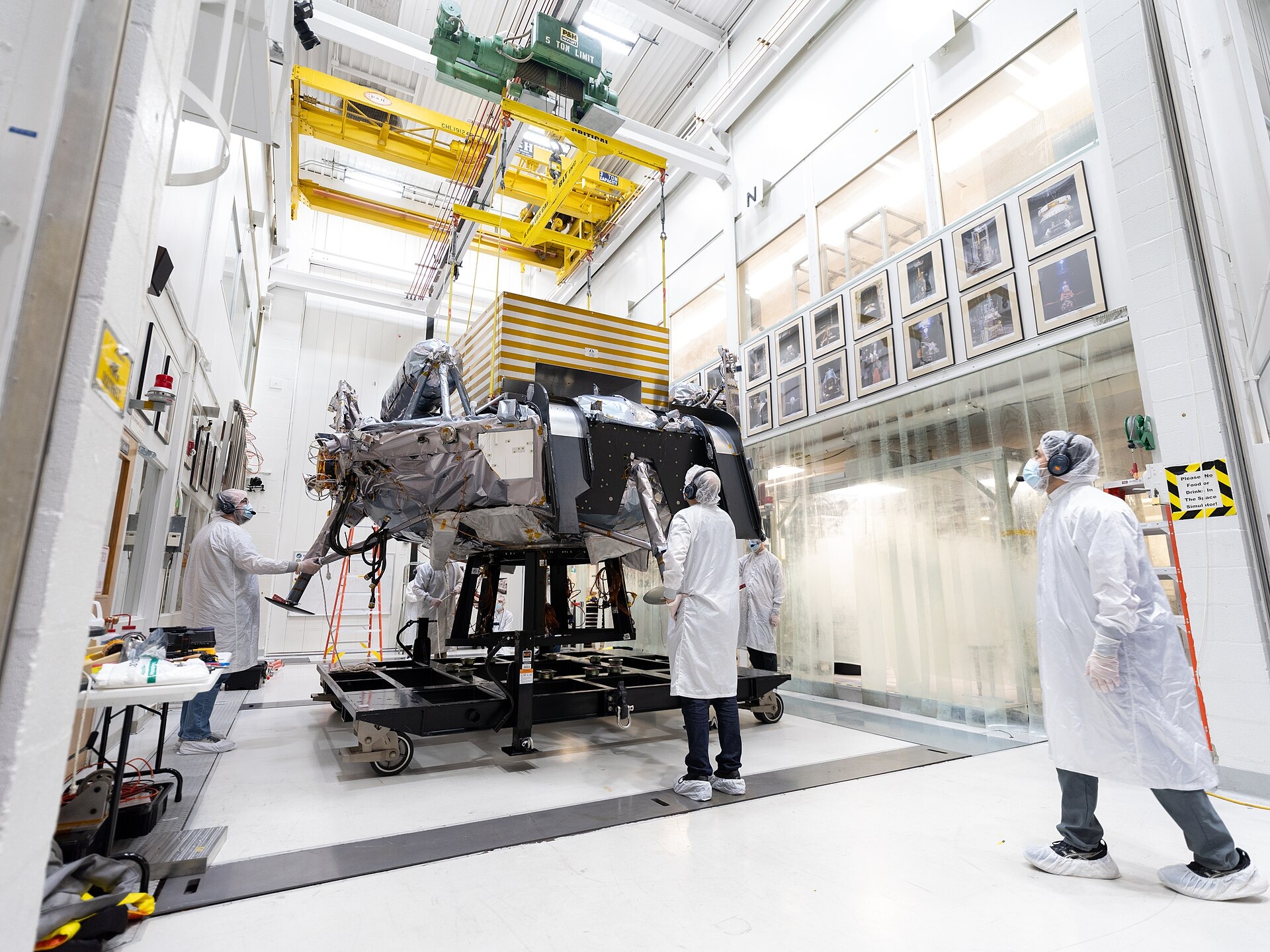
The 25-Foot Space Simulator holds an illustrious pedigree, listed on the National Register of Historic Places for qualifying historic American missions, including the Ranger, Surveyor, Mariner, and Voyager spacecraft since the 1960s [s1]. Technicians hoisted Griffin-1 into the towering chamber, which was subsequently depressurized to deep vacuum and chilled with liquid nitrogen shrouds while solar simulation lamps illuminated the craft [s1].
During these thermal vacuum cycles, Griffin-1 was subjected to temperature extremes ranging from a frozen low of minus 148 degrees Fahrenheit (minus 100 degrees Celsius) to a blistering high of 167 degrees Fahrenheit (75 degrees Celsius) [s1]. Engineers monitored the spacecraft's thermal blankets, operational heat pipes, internal radiators, and electric heaters to confirm that critical avionics and propulsion subsystems remain within safe operational bounds throughout transit and lunar surface operations [s1]. Affixed atop the lander was a distinctive yellow-striped mass simulator representing Astrolab’s FLIP (FLEX Lunar Innovation Platform) rover, allowing the team to simultaneously verify thermal dissipation under representative cargo configurations [s1].
Rotational Dynamics and Electromagnetic Compatibility
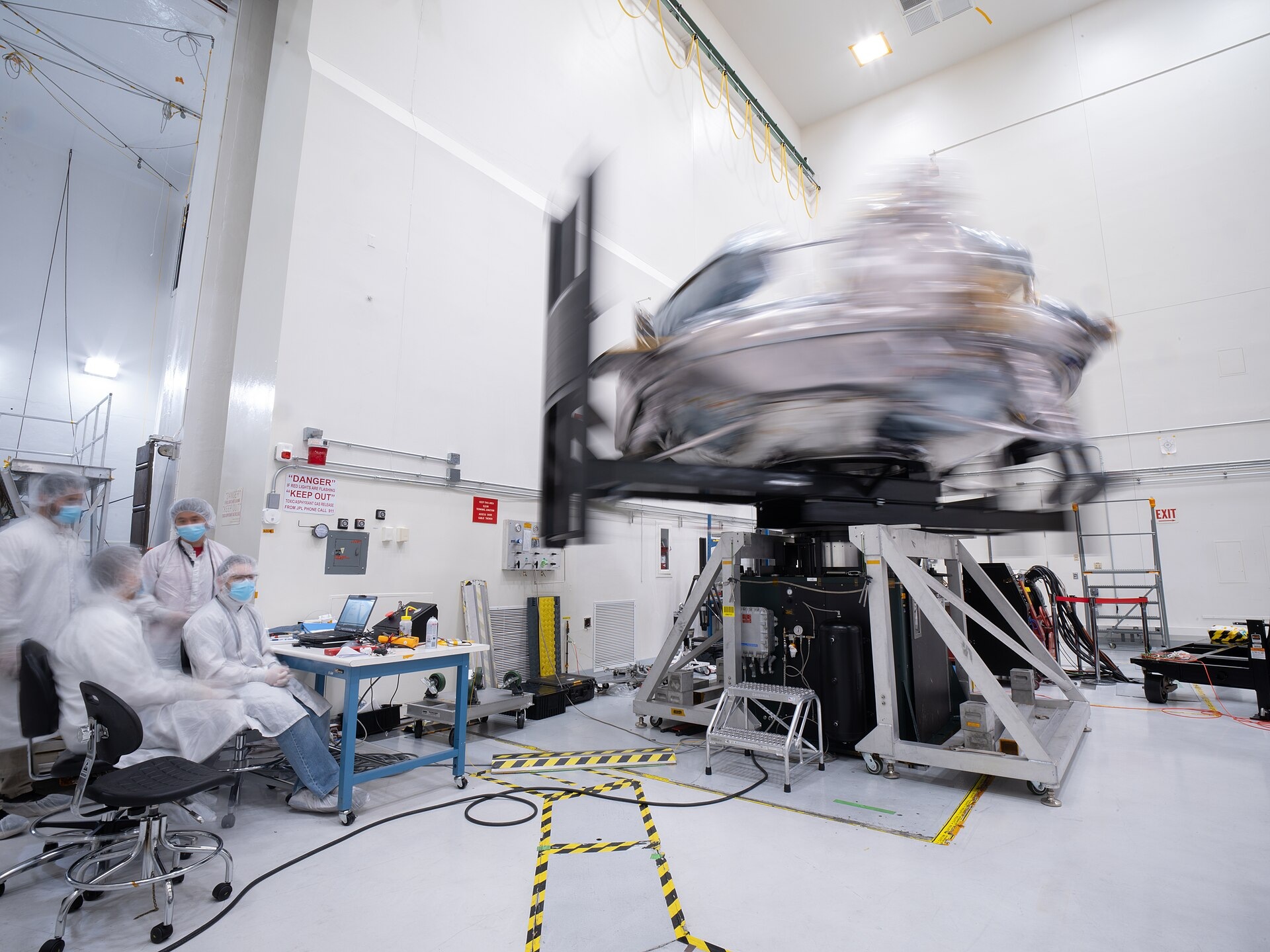
Environmental qualification requires more than structural and thermal survival; it mandates precise physical and electromagnetic characterization. On July 20, prior to acoustic and thermal testing, technicians secured Griffin-1 onto a specialized rotational platform to evaluate its mass properties [s1]. By spinning the spacecraft rapidly, engineers mapped its precise center of gravity and moments of inertia, searching for subtle wobbles or dynamic imbalances [s1]. Confirming these mass properties provides critical inputs to the guidance, navigation, and control (GNC) algorithms that will fire Griffin-1's descent thrusters during automated lunar landing maneuvers [s1].
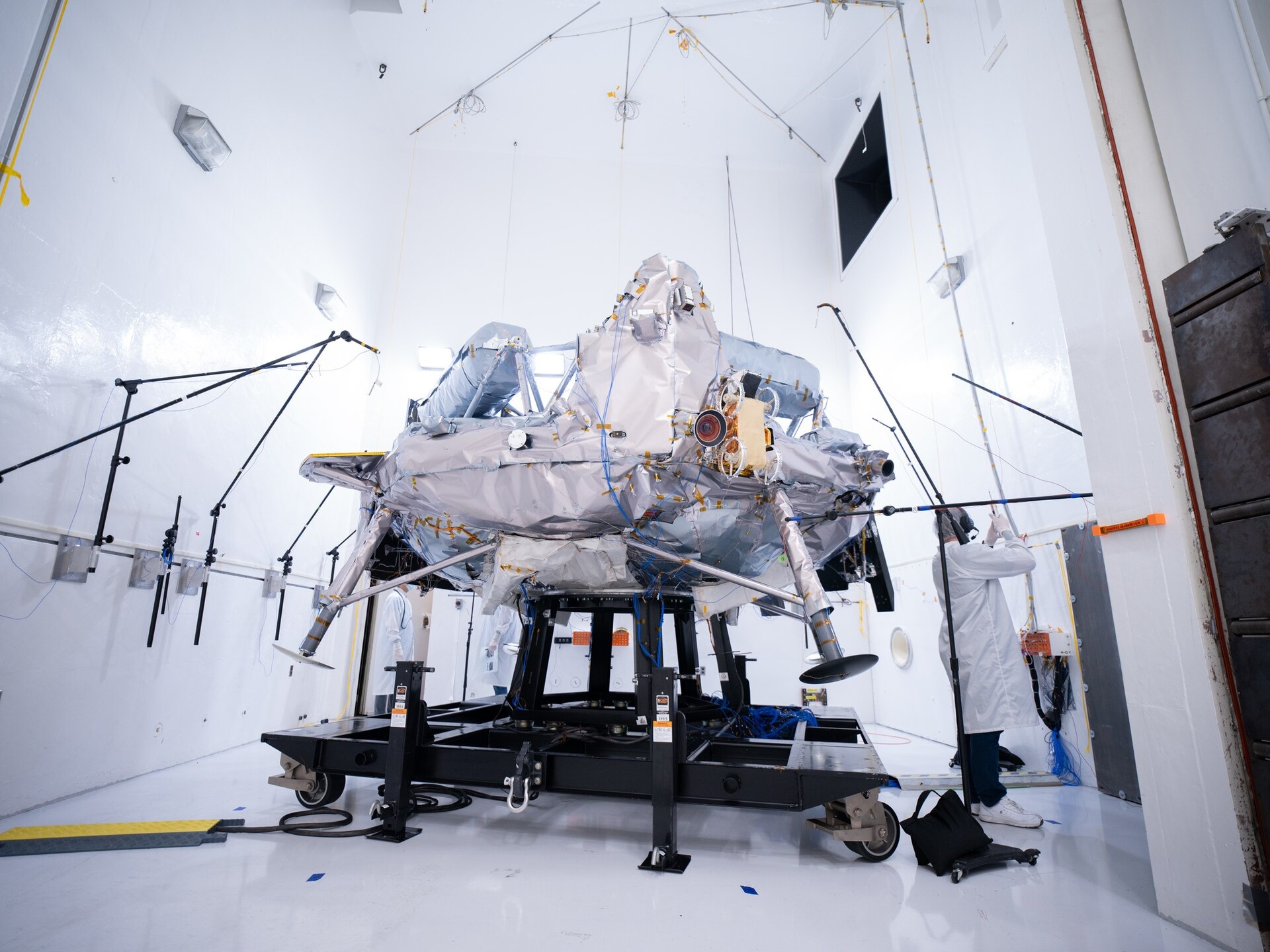
On July 29, the lander moved into an anechoic chamber lined with sound- and radio-frequency-absorbent carbon-impregnated foam cones for electromagnetic interference (EMI) and electromagnetic compatibility (EMC) testing [s1]. Because modern robotic landers carry high-gain communication antennas, radar altimeters, onboard computers, and scientific instruments, electronic signals must not unintentionally interfere with one another [s1]. The anechoic testing confirmed that Griffin-1's communication systems and sensor suites operate cleanly without generating electromagnetic crosstalk capable of compromising navigation or mission telemetry [s1].
Final Integration and the Path to the Lunar South Pole
With its three-month environmental test campaign at JPL successfully concluded, Griffin-1 was packaged and transported across the country to Voyager Lunar Systems’ facility in Pittsburgh for final integration and assembly [s1]. There, technicians will complete final payload integration, replacing mass simulators with actual flight hardware, including the FLIP rover [s1].
Griffin-1 is scheduled to launch in late 2026 aboard a SpaceX Falcon Heavy rocket [s1]. Operating as an infrastructure-class lander under NASA’s CLPS initiative, the mission is slated to transport more than 1,100 pounds (455 kilograms) of cargo directly to the lunar surface [s1]. The payload manifest includes 10 discrete instruments and technologies supplied by six different nations, reflecting the expanding international architecture of contemporary lunar exploration [s1].
The designated destination for Griffin-1 is Nobile Crater, located near the Moon's South Pole [s1]. The lunar polar regions are of paramount scientific and strategic interest due to permanently shadowed regions that may harbor volatile water ice deposits. Delivering heavy payloads and mobility platforms to this rugged polar terrain represents a major test of commercial lunar logistics. With its environmental gauntlet at JPL complete, Griffin-1 has demonstrated that its design can withstand the violent journey from Earth's launchpads to the frozen craters of the Moon [s1].
Sources & further reading
[s1] Voyager Technologies’ Griffin-1 Completes Environmental Testing at NASA JPL - NASA Science ↗science.nasa.gov · 2026-10-13
Updated 18/10/2026. Report a correction.Image credits
Source image · Voyager Technologies’ Griffin-1 Completes Environmental Testing at NASA JPL (PIA26708 figC) · NASA/JPL-Caltech · Public domain · Original image and rights details ↗
Source image · Voyager Technologies’ Griffin-1 Completes Environmental Testing at NASA JPL (PIA26708 figD) · NASA/JPL-Caltech · Public domain · Original image and rights details ↗
Source image · Voyager Technologies’ Griffin-1 Completes Environmental Testing at NASA JPL (PIA26708) · NASA/JPL-Caltech · Public domain · Original image and rights details ↗
Source image · KSC-20210326-PH-ILW01 0106 - Kevin Smith and Janine Captain during MSolo Connectivity Test · Isaac Watson · Public domain · Original image and rights details ↗
Source image · Voyager Technologies’ Griffin-1 Completes Environmental Testing at NASA JPL (PIA26708 figA) · NASA/JPL-Caltech · Public domain · Original image and rights details ↗