A Familiar Puzzle and a Wild Idea
Look out into the night sky, and space appears remarkably uniform in every direction. Whether astronomers observe billions of light-years to the north or south, the temperature of the cosmic microwave background—the faint thermal afterglow left behind by the early universe—is virtually identical everywhere. In the early 1980s, physicist Alan Guth proposed the theory of cosmic inflation to solve this profound puzzle. According to the inflationary framework, the early universe underwent a brief burst of exponential expansion, stretching space flat and evening out any initial irregularities.
In standard introductory accounts, inflation is described as a transient phase that ended everywhere before our hot Big Bang began. However, theoretical investigations into inflationary mechanisms revealed a dramatic alternative: in many models, cosmic expansion never concludes universally. Instead, it leads to eternal inflation, generating an endless succession of isolated pocket universes that are theoretically predicted to remain fundamentally unobservable from within our own vantage point [s1]. Rather than a single cosmic event, our universe may simply be one tranquil bubble formed in a relentless, self-sustaining cosmological expansion.
How Quantum Jumps Fuel an Endless Engine
To understand why inflation might continue indefinitely, physicists examine the subtle interplay between gravity and quantum mechanics. During inflation, space is stretched by a high-energy scalar field. As this field attempts to settle down into a lower-energy resting state—a transition that halts inflation and triggers a local Big Bang—it is continually buffeted by microscopic quantum fluctuations.
In certain regions, these quantum kicks nudge the field toward its resting state, bringing rapid expansion to a stop. The energy stored in the field is released into elementary particles and radiation, forming a distinct pocket universe. Yet, because of the theory's mathematical structure, the infinite pocket universes generated in this process are predicted to be entirely unobservable directly from within any single pocket [s1].
In neighboring regions, random quantum fluctuations push the field back in the opposite direction, prolonging the rapid inflationary stretching. Because inflating space expands exponentially, inflating regions grow dramatically faster than the rate at which decay occurs. As a result, the volume of inflating space continues to multiply without limit, transforming inflation into an unstoppable cosmic engine that produces new bubbles forever [s1].
Trapped in an Unseen Cosmic Foam
If our cosmos is just one bubble floating in an infinite ocean of eternal inflation, could future technology ever glimpse our neighboring realms? Within standard theoretical models, the answer is a decisive no: the infinite pocket universes generated by eternal inflation are predicted to be unobservable directly from inside our own universe [s1].
The barrier preventing observation is the physics of cosmic expansion itself. The space separating individual pocket universes inflates at speeds that outpace the speed of light. Because no physical signal or ray of light can travel across space faster than light, any incoming photons from an adjacent pocket universe are swept backward by the rapid stretching of the intervening space [s1].
Cosmologists have explored theoretical edge cases, such as searching for collision signatures or subtle bruised disks in the cosmic microwave background that might arise if another bubble grazed ours during its earliest moments of growth. However, absent such a rare collision, our observable cosmos remains completely cut off from the rest of the multiverse, permanently enclosed by its own cosmological horizon [s1].
The Bizarre Math of Infinite Universes
Even if other bubble universes remain forever unobservable, eternal inflation has profound implications for theoretical physics because it completely reshapes how scientists calculate probabilities. Yet, moving to an infinite multiverse introduces a perplexing challenge known as the 'measure problem' [s1].
In an eternally inflating spacetime that generates infinite numbers of pocket universes, every physical event that is possible will happen an infinite number of times. When theorists attempt to calculate the likelihood of observing specific physical parameters—such as the cosmological constant or the mass of fundamental particles—standard probability calculations break down, forcing physicists to compare infinity to infinity.
Depending on how one chooses to count and regularize these infinite volumes, the mathematics can produce bizarre theoretical artifacts. Alan Guth highlighted this problem through the 'youngness paradox,' which emerges when applying a synchronous gauge regularization technique to eternally inflating spacetimes [s1]. Because volume grows exponentially over time, later-forming universes outnumber earlier ones by astronomical margins. Taken at face value, this mathematical method suggests that vastly younger universes should dominate the probability distribution, leading to conclusions that conflict with our own measured cosmic age [s1]. Overcoming these probability ambiguities remains one of modern cosmology's most stubborn puzzles.
An Eternal Future, but a Definite Beginning
The idea that cosmic inflation can continue endlessly into the future inevitably raises a fundamental question about cosmic beginnings: could inflation also have been eternal into the past, meaning the universe never had a starting point at all?
Theoretical physics provides a clear and surprising constraint. While inflation is generically eternal into the future, mathematical proofs demonstrated under reasonable assumptions show that an inflating region cannot be eternal into the past [s1]. In particular, theorems governing expanding spacetimes establish that the inflating region must be past-incomplete along past-directed paths [s1].
This means that eternal inflation cannot sidestep the problem of cosmic origins. Even an infinitely reproducing multiverse could not have existed forever without a beginning. Instead, some physical framework other than inflation—such as an era described by quantum gravity or a completely new theoretical mechanism—is required to describe the past boundary of the inflating region [s1]. While eternal inflation suggests our Big Bang was not the absolute beginning of everything, it leaves the mystery of the ultimate origin firmly intact.
Sources & further reading
[s1] [hep-th/0702178] Eternal inflation and its implications ↗arxiv.org
Updated 20/10/2026. Report a correction.Image credits
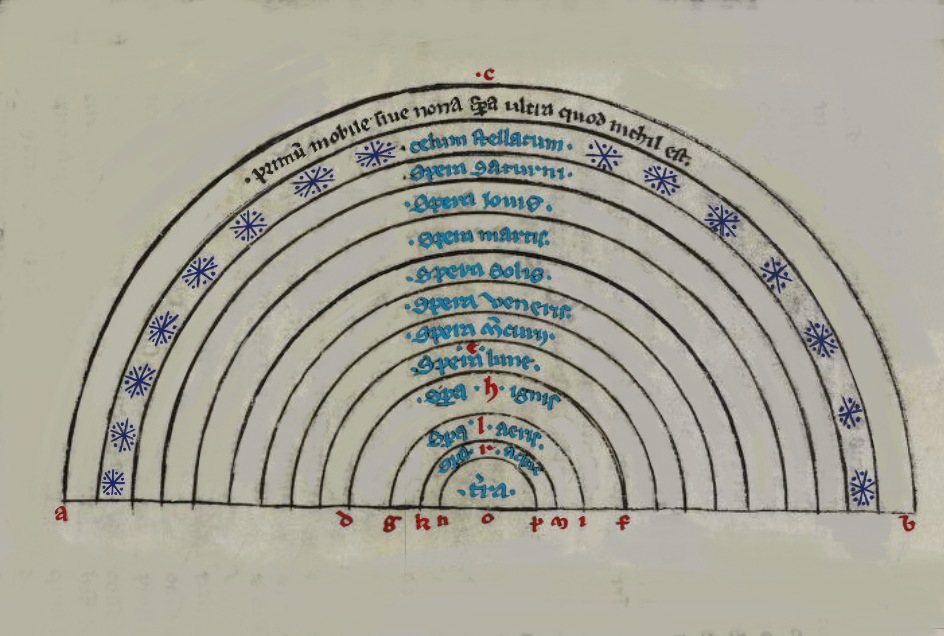
Related source image: Cosmological diagram from Robert Grosseteste’s De Sphaera (13th century)
Source image · Multiverse · KronicTOOL · Public domain · Original image and rights details ↗
Source image · Age by redshift · Sandizer · CC0 · Original image and rights details ↗
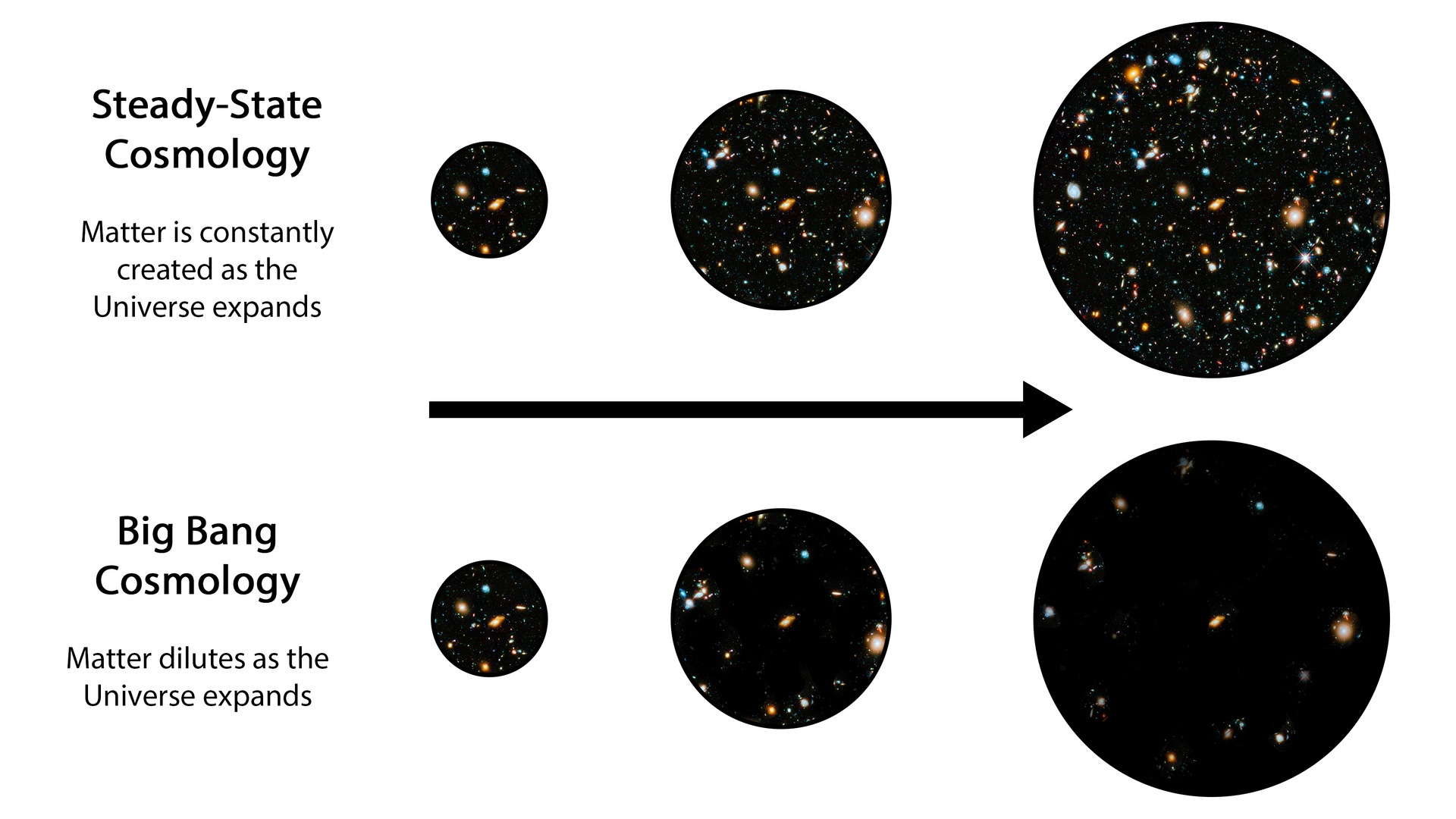
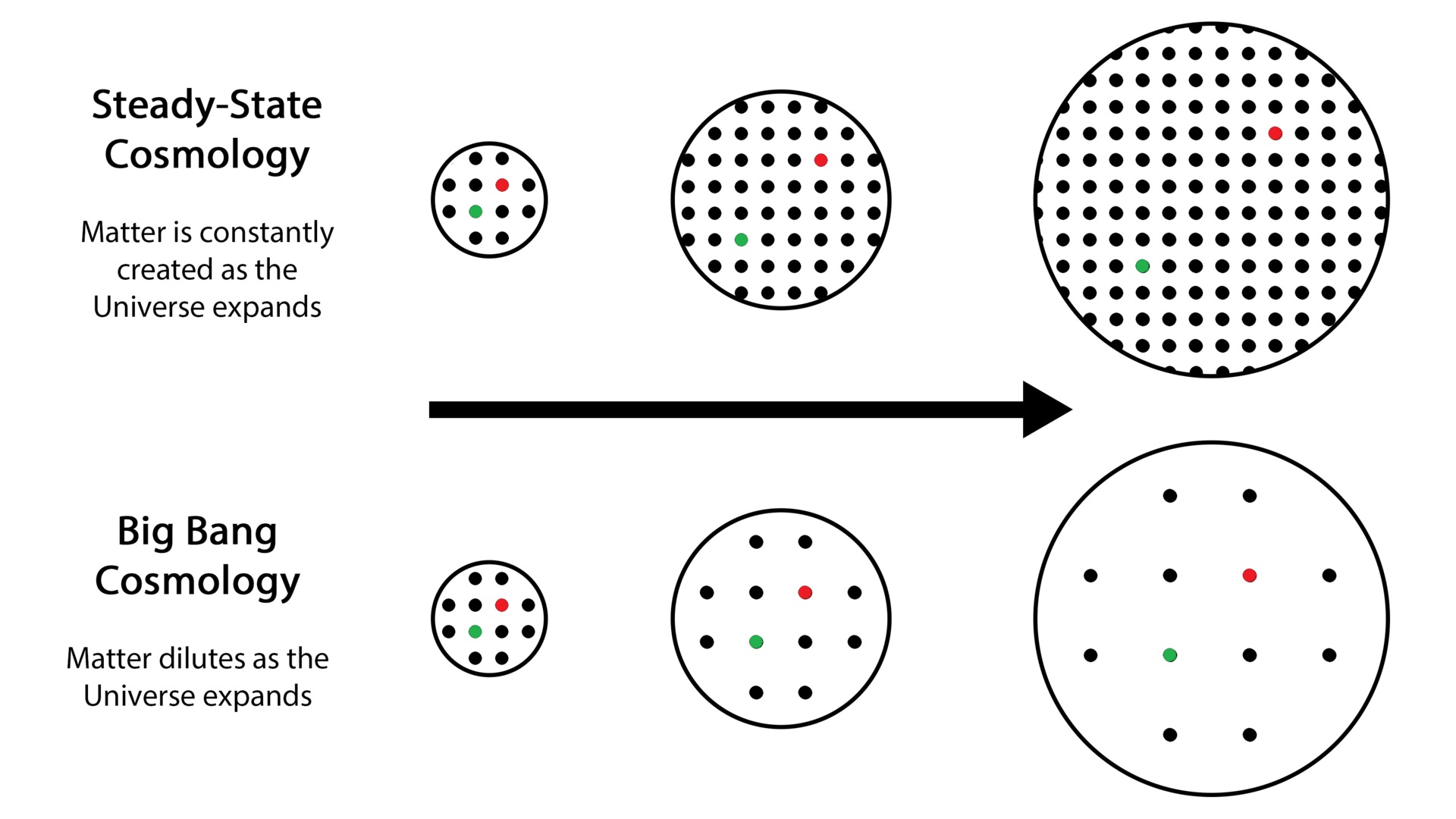
Source image · Big Bang and Steady-State Theory 2 · Artistosteles · CC0 · Original image and rights details ↗
Source image · Big Bang and Steady-State Theory · Artistosteles · CC0 · Original image and rights details ↗
Source image · Cosmological diagram from Robert Grosseteste’s De Sphaera (13th century) · Cosmosanchez · CC0 · Original image and rights details ↗