The Labyrinth of Local Solar Time
For most of human civilization, timekeeping was an intensely local practice governed strictly by nature. In the nineteenth century, North American cities set their civic clocks by measuring the path of the sun across the meridian, establishing noon as the moment the sun reached its zenith [s1]. Because the Earth completes a 360-degree rotation approximately every 24 hours, the solar meridian advances at a rate of 15 degrees of longitude per hour, or roughly one degree every four minutes. Consequently, even towns separated by only a few miles experienced different local solar times.
In pre-industrial societies, these minor temporal disparities caused little inconvenience. Daily affairs were tethered to horse-drawn travel and foot traffic, which moved too slowly for a discrepancy of several minutes to disrupt commerce or daily life. However, by the late nineteenth century, the rise of industrial manufacturing and regional commerce rendered this decentralized approach unwieldy. In North America, the continent-wide landscape of independent municipalities had produced a chaotic patchwork of over 144 localized time zones [s1]. Every city hall, municipal clock tower, and jeweler operated as an autonomous temporal authority, setting clocks according to idiosyncratic astronomical sightings that defied regional coordination [s1].
The Railroad Dilemma and Early Reformers
The fundamental catalyst for transforming timekeeping was the rapid expansion of the iron railroad. Following the passage of the Pacific Railway Act of 1862, which funded the construction of the transcontinental railroad, track networks expanded dramatically; by 1865, an estimated 35,000 miles of track spanned the United States [s1]. As locomotives traversed hundreds of miles in a single day, maintaining local solar time became an operational hazard. Rail companies required precise schedules not only to ensure prompt connections for passengers and freight, but to avert devastating head-on collisions on single-track lines [s1].
To navigate the chaos, rail operators established their own internal time standards, typically calibrating departures to the local time of their headquarters or primary terminal [s1]. Yet this corporate self-regulation created a secondary dilemma. By the early 1880s, despite various mergers, travelers and rail operators still contended with approximately 80 different railroad time standards across North America [s1]. Major terminals displayed clusters of clocks, each ticking to the standard of a different regional carrier alongside the host city's local solar time [s1]. As educator and reformer Charles F. Dowd observed, “The traveler’s watch was to him but a delusion; clocks at stations staring each other in the face defiant of harmony either with one another or with surrounding local time and all wildly at variance with the traveler’s watch, baffled all intelligent interpretation” [s1].
Architects of the Meridian Framework
The intellectual blueprint for rectifying this confusion came from an alliance of visionary educators, civil engineers, and astronomers. In 1870, Charles F. Dowd published his pioneering pamphlet, “A System of National Time and its Application, by Means of Hour and Minute Indexes, to the National Railway Time-table” [s1]. Dowd proposed dividing North America into four distinct time zones, spaced precisely one hour apart and anchored to meridians west of Greenwich: the 75th, 90th, 105th, and 120th meridians [s1]. Meanwhile, in 1876, Sir Sanford Fleming, chief engineer of Canada’s Governmental Railways, published his memoir *Terrestrial Time*, urging an international 24-hour universal standard [s1]. In 1879, meteorologist Cleveland Abbe persuaded the American Meteorology Society to establish the Committee on Standard Time, arguing that simultaneous weather observations required synchronized clocks [s1].
Wary of heavy-handed government intervention that could compromise corporate revenues, railroad executives took the initiative [s1]. In October 1881, the General Time Convention tasked its secretary, William F. Allen—who also published the *Traveler’s Official Railway Guide*—with crafting a definitive proposal [s1]. Allen blended Dowd’s geometric elegance with the practical demands of operating lines, consulting rail engineers throughout the nation [s1]. On October 11, 1883, Allen presented his finished system at the Grand Pacific Hotel in Chicago, establishing five regional zones keyed to Greenwich mean sun-time [s1]. Railroad executives voted overwhelmingly in favor, resolving to enact the new standard across all North American lines at noon on November 18, 1883 [s1].
The Day of Two Noons and Cultural Backlash
Implementing this nationwide synchronization required extraordinary logistical coordination. Rather than relying on legislation, rail companies mounted a public campaign, dispatching representatives to municipal governments and circulating detailed instructional guides and maps through daily newspapers [s1]. High-precision astronomy served as the backbone of the rollout: both the United States Naval Observatory and Pittsburgh's Allegheny Observatory synchronized telegraph networks to transmit automated noon time-signals along railroad telegraph wires [s1].
On Sunday, November 18, 1883, the historic transition took place [s1]. In numerous cities along boundary zones, clocks officially struck noon twice—first according to their traditional local solar time, and then a second time when the telegraphic standard pulse arrived [s1]. The event entered the popular lexicon as the “Day of Two Noons” [s1].
While metropolitan business communities widely applauded the system's operational clarity, conservative critics and traditionalists voiced indignation over what they saw as an unnatural subversion of celestial law [s1]. A fiery editorial in the *Indianapolis Sentinel* captured the cultural resistance to corporate temporal control: “People will have to marry by railroad time and die by railroad time. Ministers will be required to preach by railroad time—banks will open and close by railroad time—in fact, the Railroad Convention has taken charge of the time business, and the people may as well set about adjusting their affairs in accordance with its decree…We presume the sun, moon and stars will make an attempt to ignore the orders of the Railroad Convention, but they, too, will have to give in at last” [s1].

From Corporate Compromise to Federal Law
Despite philosophical outrage, practical utility swiftly eclipsed traditionalist complaints. Most municipalities adopted railroad time within days or months of November 18, 1883, recognizing that commercial isolation was the only alternative [s1]. Standardized time quickly became the fundamental architecture organizing factory shifts, bank exchanges, postal delivery, school bells, and urban transit across the industrial world.
The rail industry’s private agreement governed North American civil time for more than three decades before federal authorities intervened. In 1918, during the mobilization of the First World War, the United States Congress formally enacted the Standard Time Act (40 Stat. 450) [s1]. The legislation placed regulatory authority over time zone boundaries under the Interstate Commerce Commission and instituted a temporary regime of Daylight Saving Time [s1]. Later adjustments followed, including year-round daylight saving during World War II under the War Time Act of 1942, and the comprehensive Uniform Time Act of 1966 signed by President Lyndon B. Johnson to establish national consistency among the states [s1].
Although modern passenger transit has evolved from steam locomotives to commercial aviation and digital telecommunications, the discrete longitudinal bands established on that cold November noon in 1883 endure. By decoupling civic life from local solar noon, the nineteenth-century railroad network laid the invisible foundation of our synchronized global civilization [s1].

Sources & further reading
[s1] Whose Time is it Anyway? A Brief History of Standardized Time Zones in the United States | In Custodia Legis ↗blogs.loc.gov
Updated 20/10/2026. Report a correction.Image credits
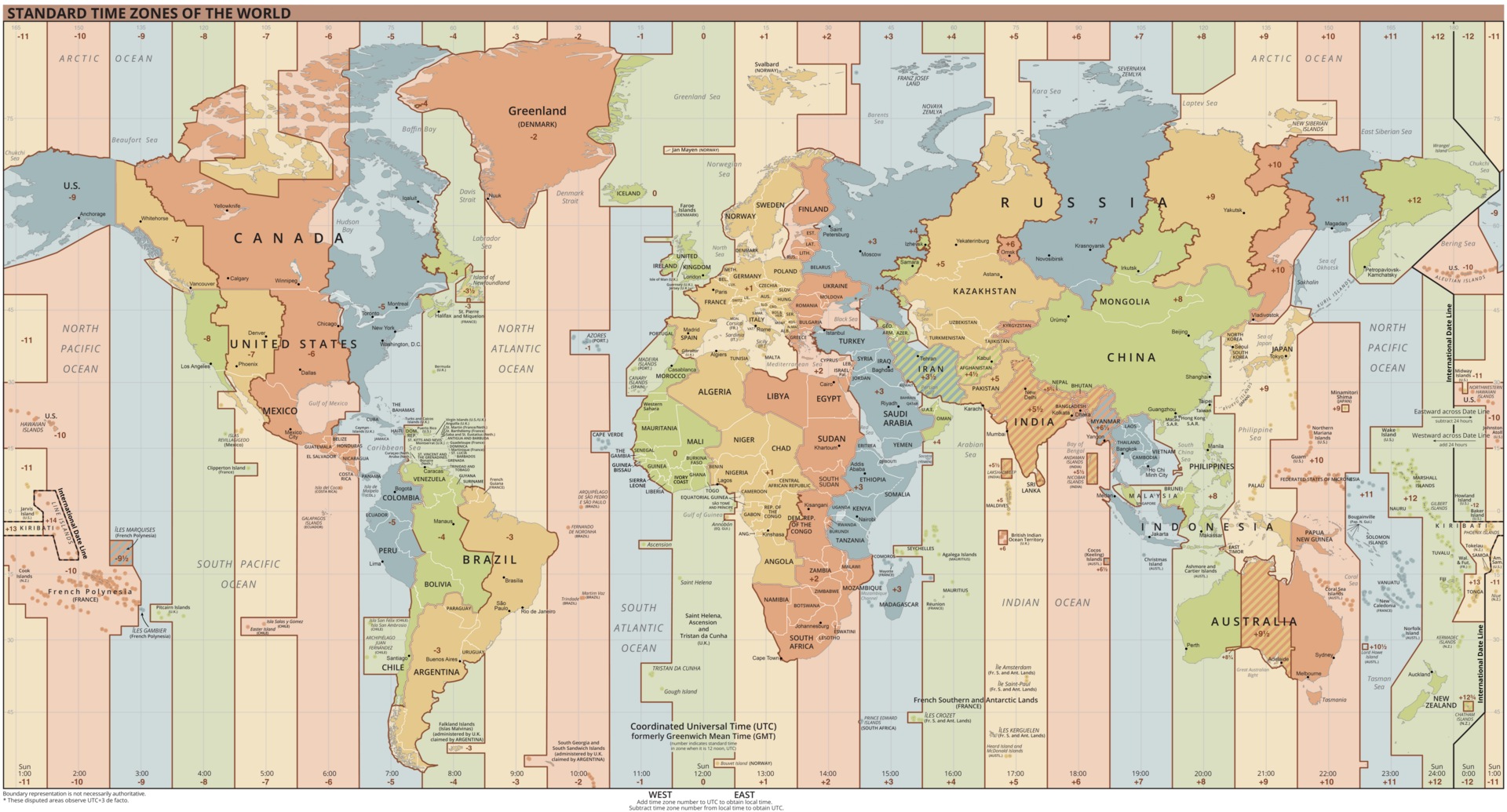
Related source image: World Time Zones Map
Source image · 19th century money box · Prolete · CC0 · Original image and rights details ↗
Source image · Forge House, Upper Sea Road, Old Town, Bexhill · Alexis Markwick · CC0 · Original image and rights details ↗
Gemini-generated conceptual illustration · COSMORA
Source image · World Time Zones Map · UnaitxuGV, Heitordp and others · Public domain · Original image and rights details ↗