Foundations of an Urban Network
The ancient cities of the Indus Valley represent one of the most remarkable and enigmatic chapters in the history of global urbanism. Flourishing across modern-day Pakistan and northwestern India, the Indus Civilization—frequently identified by its major type-site Harappa—spanned nearly two millennia between approximately 3200 and 1300 BC [s1]. Far from emerging abruptly as an isolated anomaly, this vast civilizational matrix drew upon foundational village and town traditions whose regional roots extended as far back as 7000 BC [s1]. Over millennia of cumulative development, early agricultural and pastoral communities gradually expanded their spatial distribution, established interregional exchange networks, and refined regional craft and metallurgical technologies [s1].
What distinguishes the Indus urban phenomenon from its contemporary Bronze Age counterparts in Mesopotamia and the Nile Valley is the extraordinary consistency of its material culture and civic layout. As settlement networks expanded across vast river basins and alluvial plains, communities adopted cohesive spatial practices and infrastructural traditions. Foremost among these material markers was the widespread reliance on standardized mud and kiln-fired bricks to erect domestic quarters, civic platforms, and hydraulic networks. By analyzing how these basic structural modules were manufactured and deployed across hundreds of settlement sites, archaeologists have increasingly sought empirical measures to reconstruct the organizational dynamics and socioeconomic cohesion that knit this vast ancient society together.
The Mature Harappan Climax
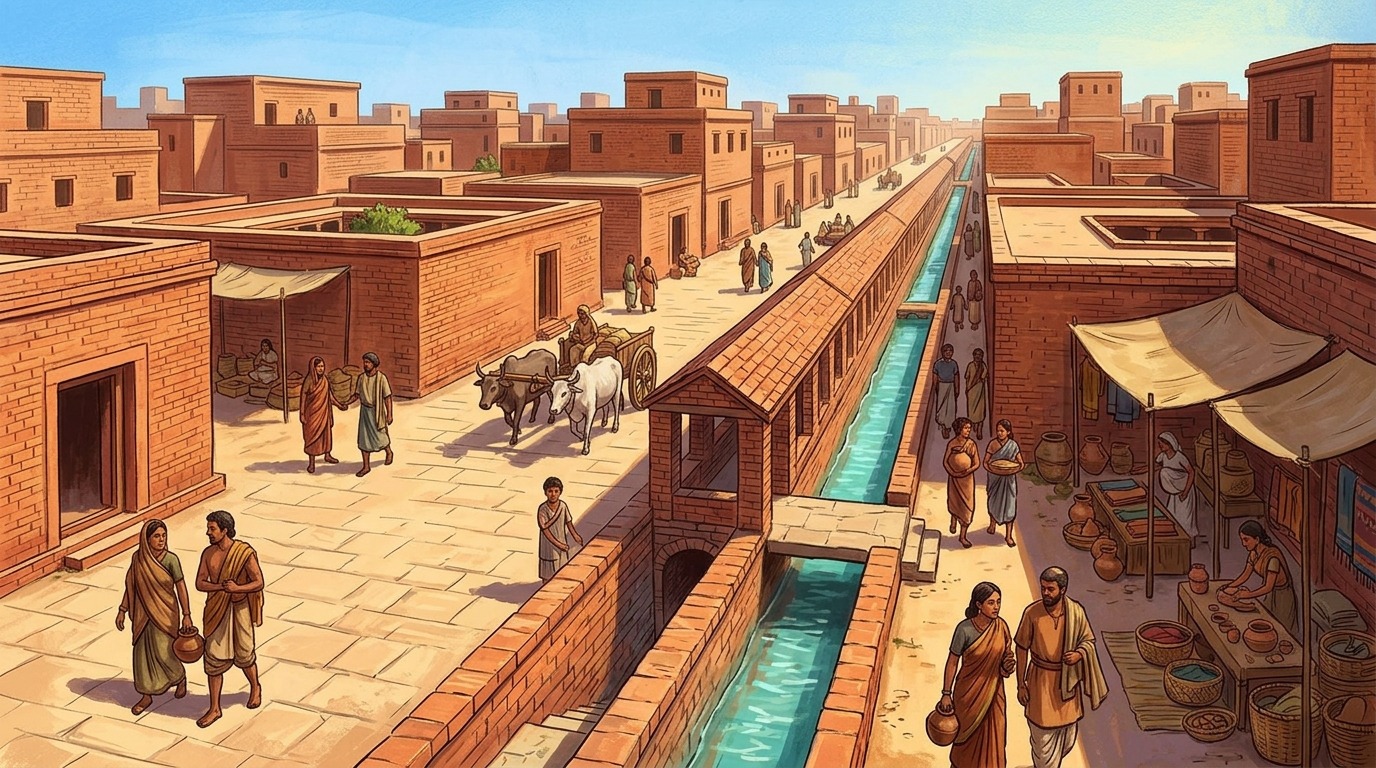
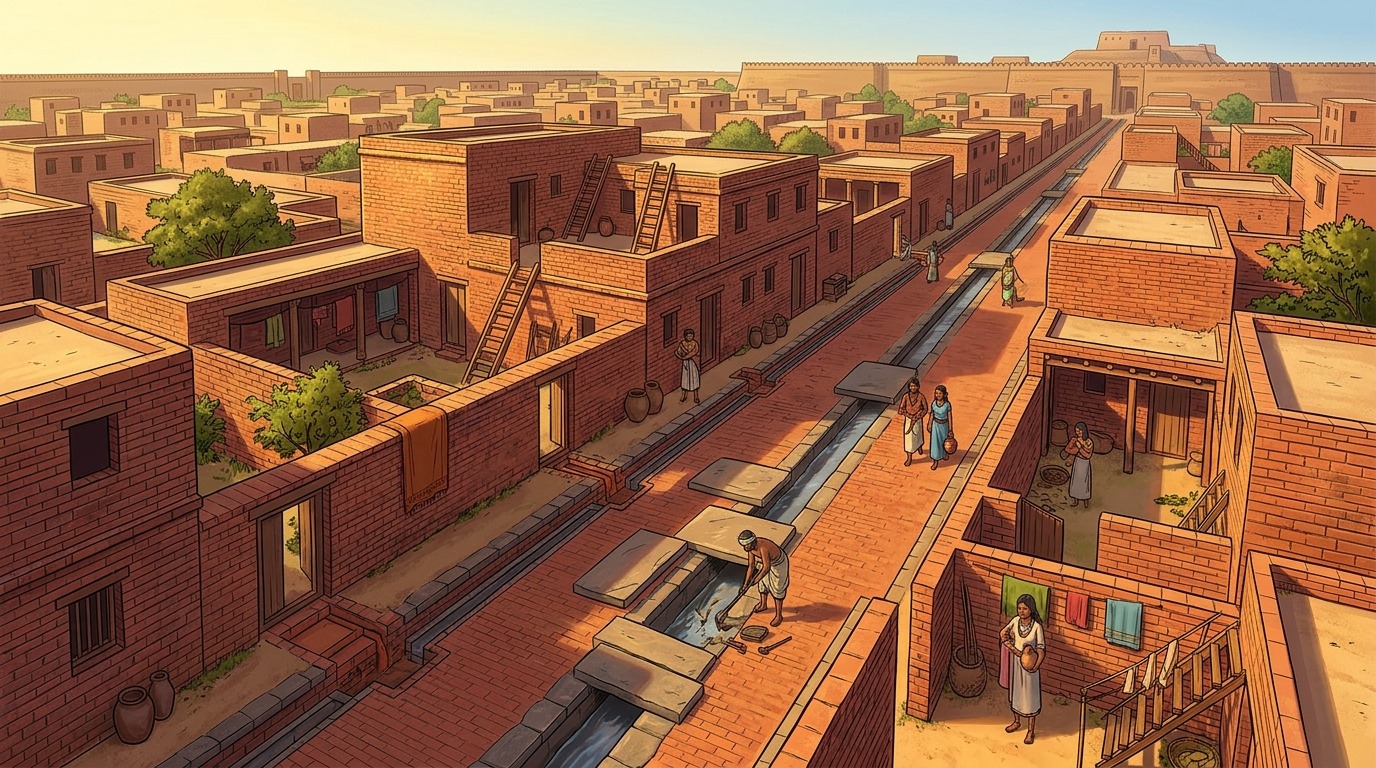
The developmental trajectory of the Indus Civilization culminated between 2600 and 1900 BC in what archaeologists designate the Mature Harappan phase [s1]. During this seven-century peak, the civilization established expansive, meticulously structured metropolitan hubs, most famously Harappa and Mohenjo-daro [s1]. These urban settlements were defined by sophisticated civil engineering, including fortified citadels, partitioned lower towns, and extensive covered drainage systems designed to manage wastewater and seasonal runoff. Urban streets were frequently laid out along orderly, rectilinear alignments, reflecting an unprecedented degree of municipal coordination.
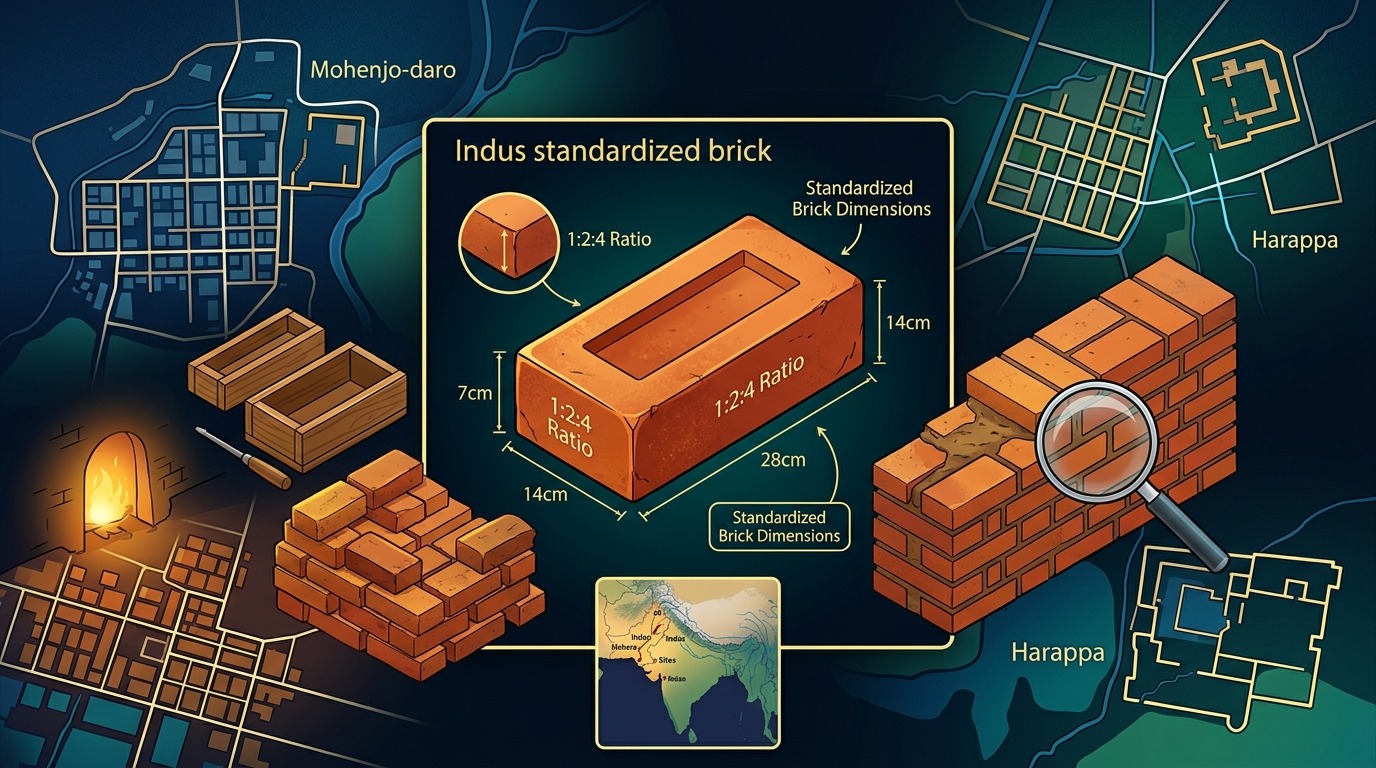
Simultaneously, the Mature phase witnessed the proliferation of a distinct script, standardized weights and measures, and widespread political administration that regulated long-distance exchange [s1]. Unlike the monumental stone palaces and towering temples characteristic of Egyptian or Mesopotamian capitals, Indus urbanism prioritized utilitarian civil engineering executed in mud and fired terracotta brickwork. Kiln-fired bricks, which provided exceptional durability and moisture resistance, were especially critical in constructing public baths, wells, and drainage conduits. The ubiquity of standardized brick dimension ratios across diverse settlements points to deeply embedded technological norms, whether coordinated through centralized political oversight or sustained by pervasive, self-regulating craft traditions among Harappan builders.
Quantitative Proxies in Brick Typology
To move beyond purely qualitative descriptions of Harappan grandeur, archaeological researchers have turned to quantitative meta-analyses of material culture. In an exploratory physics-history study submitted to the arXiv repository, researchers Aurangzeb Khan and Carsten Lemmen synthesized literature estimates covering brick typology and individual urban settlement areas across the Indus domain [s1]. Their preliminary research model evaluates how changes in brick manufacturing standards correspond to settlement growth, density, and spatial distribution across successive archaeological eras [s1].
Because bricks constituted the primary modular building block of Indus municipal architecture, fluctuations in their typology, dimensions, and production intensity offer an empirical proxy for civil cohesion and infrastructure investment. In Khan and Lemmen's preliminary framework, combining spatial data on urban surface area with chronological layers of architectural material provides a quantitative lens into how urban centers expanded during the Mature period and subsequently contracted [s1]. As an unreviewed preprint, Khan and Lemmen’s synthesis presents preliminary quantitative modeling rather than definitive historical consensus, yet it illustrates how physical artifact metrics and spatial settlement footprints can formalize archaeological inquiries into civilizational tempo.
The Riddle of Indus Deurbanization
During the centuries following 1900 BC, the cohesive fabric of the Mature Harappan world began to unravel. Over an ensuing six-hundred-year span, hallmark technological traditions fell out of use, writing and standardized weight systems vanished, monumental public works ceased, and major urban centers experienced widespread depopulation [s1]. Inhabitants increasingly migrated away from the former core settlement river basins toward regional peripheries, marking a profound shift toward localized, non-urban agrarian communities [s1]. Archaeological evidence reveals that municipal maintenance lapsed, civic drainage systems fell into disrepair, and fired brick construction gave way to smaller, ad-hoc structures.
Despite decades of intense archaeological investigation and dozens of competing hypotheses, researchers have not established a conclusive causal chain explaining this sweeping deurbanization [s1]. Proposed mechanisms range from environmental perturbations—including shifting monsoon precipitation patterns and the desiccation or rerouting of perennial river systems—to the disintegration of vital mercantile networks and internal sociopolitical fragmentation. By systematically linking artifact find-site data with urban surface area calculations and brick typology shifts, modern spatial modeling aims to establish the chronological pacing of this decline [s1]. Understanding whether urban centers collapsed synchronously or fragmented through protracted regional reorganizations remains one of the most compelling open questions in ancient history.
Sources & further reading
[s1] [1303.1426] Bricks and urbanism in the Indus Valley rise and decline ↗arxiv.org
Updated 17/10/2026. Report a correction.